When Teaching Becomes Surveillance
AI cheating is a real problem. But screen monitoring also exposes an exam model that trusts students only when they work alone.
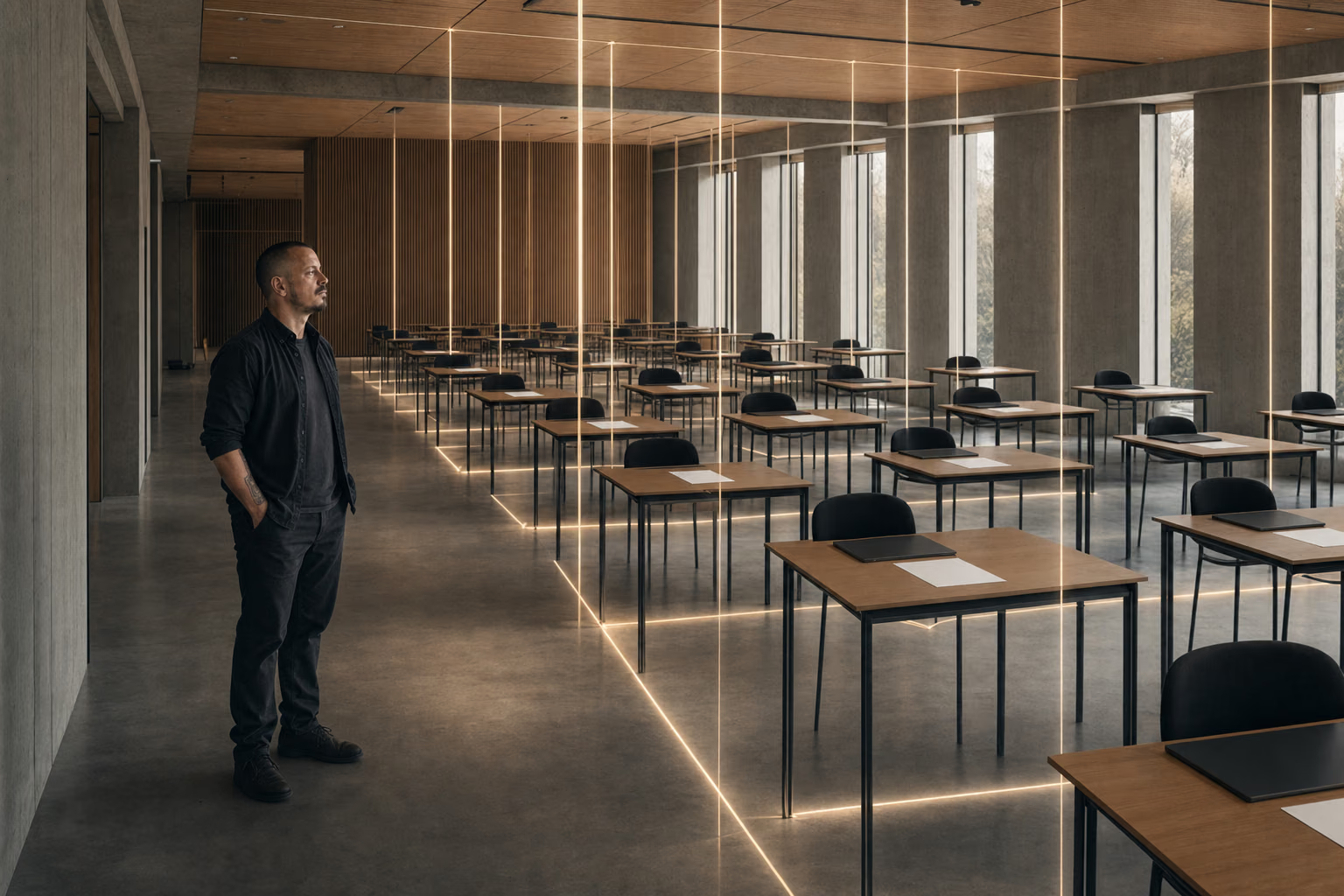
It is not difficult to understand why schools are worried.
A student can ask a language model to write a coherent analysis, solve a programming task or produce an assignment in seconds. The teacher can see the finished product, but not necessarily the path the student took to get there. If a grade is meant to say something about the student’s own level, that is a real problem.
That is why Denmark’s Ministry of Education published an emergency package against AI cheating in August. It includes oral defences of take-home assignments, encouragement to use monitoring tools during written exams, and more written work at school under controlled conditions.
It is easy to respond with principled outrage at the monitored screen. That would be too simple. Some skills must be demonstrated without assistance. A school also needs to give grades that others can trust. And a student who never attempts to formulate a thought herself does not merely gain an unfair advantage. She loses the resistance that makes thinking possible.
But the package raises a larger question than it tries to answer.
What, exactly, does the school want to see?
The more we have to monitor a student’s access to the world in order to believe her work, the clearer it becomes that we are defending a particular way of measuring: an exam model that is credible when the student works alone, with limited aids, in a closed room.
AI does not create that conflict. It makes it visible.
The Closed Exam
The written exam has long been an elegant institutional machine. It creates roughly equal conditions. It limits assistance. It makes results comparable. We may disagree about grades, but at least we know what was measured: What could this person produce under these conditions?
That is not insignificant knowledge.
We want to know whether a doctor understands anatomy before consulting a system. Whether a lawyer can spot a contradiction in a case before accepting a suggestion. Whether a student can write a reasoned analysis before asking a machine to do it quickly. Not because humans must defeat machines in a duel, but because you cannot take responsibility for an answer if you lack the concepts needed to assess it.
Here the ministry is right. AI must not become a shortcut that makes the product look better than the student’s understanding.
But the closed exam is not education’s neutral default. It is a technology. It became central because it solved an administrative problem: How do we assess many people in a way that can be compared, documented and defended? It makes a particular kind of individual performance visible. In return, it makes much else invisible.
It is poor at seeing whether a student can investigate a complex problem with others. Whether she can ask an expert better questions. Whether she can discover that a convincing analysis rests on a false premise. Whether she can divide work, document uncertainty, change method or take responsibility for an error in a shared system.
These are not new abilities. But they become decisive when intelligence is no longer confined to the individual student’s head.
From Control to Insight
There is an important difference between seeing a work process and surveilling a person.
A teacher who asks a student to show her notes, explain her choice of sources or defend her analysis orally is trying to create academic insight. It may be demanding, but it has an educational direction: the student must be able to make her own work intelligible.
A screen monitor, a firewall and a controlled room point in another direction. Their primary purpose is to limit the actions that can take place. They may be necessary in a particular exam. But they do not in themselves provide a better answer to what the student should learn.
That is why the discussion of AI cheating easily becomes poorer than the problem. It becomes a discussion about how to keep AI out long enough to continue assessing the same kind of output.
But AI is not a mobile phone that can be placed in a box outside the room. It is becoming an ordinary part of the systems students will later live and work in. It will be present in search, word processors, spreadsheets, software, customer systems and decision support. Access to intelligent assistance is no longer an unusual advantage. It is becoming a condition of the world.
Schools therefore face two tasks that must not be confused.
The first is to protect situations where, for good reason, we want to know what a person can do alone. An AI-free exam can still have a place here—perhaps an even more important one, because its purpose becomes clearer.
The second is to educate people to work with agency alongside intelligence that is not their own. That task cannot be solved by turning school into a zone where such intelligence appears only as a temptation to be detected.
What Counts as the Student’s Own Work?
The question sounds banal until one tries to answer it.
Is an analysis the student’s own if she received help structuring it? What if she asked a language model for ten counterarguments and rejected nine? What if the model suggested a sentence, but she changed it because it misunderstood the source? What if two students collaborate, a third finds data, and an agent keeps track of their notes?
It would be foolish to say that everything is permitted as long as the student can explain it afterwards. Sometimes she must be able to write the first sentence herself. Sometimes she must be able to calculate without an assistant. Sometimes it is precisely her own reasoning that must be tested.
But it is equally foolish to pretend that work is authentic only when it is produced in isolation.
Elsewhere in society, we already accept that good work is distributed. No one expects an architect to design without engineers, a surgeon to work without instruments, or a researcher to reject databases and colleagues to prove independence. We assess more than the result. We ask whether the process was professionally sound, whether contributions can be traced, and whether someone takes responsibility for the whole.
That is the standard missing from the AI debate.
Not: Did the student touch AI?
But: Can the student account for what the system contributed, what she assessed herself, what might be wrong, and why the result should stand?
That is a harder test than merely submitting a successful text. It requires enough subject knowledge to see through a suggestion, enough judgement to reject it, and enough responsibility to put one’s name to it.
The New Inequality
There is also a question of equality that neither unrestricted access nor total control can solve.
Some students already know how to get a great deal from a model. They can frame a problem, identify errors, use several tools and hold their own project together. Others receive generic answers, are persuaded by fluent nonsense, or stop thinking because the machine can always write faster.
If a school simply says that AI is forbidden, it leaves that difference to the home. Students with the most access, the strongest technical language and the most support will continue learning outside school. The others encounter the tool as a prohibition or a secret.
If a school simply says that AI is permitted, the difference also grows. The strongest student gains a multiplier. The weakest gets a blank page with a friendly chatbot beside it.
The more demanding path is to make its use visible and turn it into a shared academic object. Not because everyone must become a prompt engineer, but because everyone must learn the difference between receiving an answer and being able to stand behind it.
In Formation Is Not a Sanctuary I argued that education cannot rest on the hope that there will always be a skill AI cannot perform. The same applies here. Independence cannot mean being free from influence. No one has ever thought entirely alone.
Independence must mean being able to take a position on the influences one works with.
Another Kind of Exam
This does not mean abolishing the traditional exam. It means that the traditional exam must stop pretending to be sufficient.
An education could still include short, AI-free tests of core skills. They can serve as important markers: Can the student read a text herself? Explain a calculation? Write an argument without borrowing a voice she does not understand?
But it could also assess something different and more real.
The student could submit a work log with the product: What questions did she ask, which suggestions from AI or other people did she reject, how did her understanding change, and where does uncertainty remain? She could defend a choice orally. She could be given a problem where a language model deliberately supplies a plausible error and be assessed on whether she finds it. She could work in a team where the grade does not erase individual responsibility but makes contributions, disagreement and decisions visible.
This is not a recipe. It will take time. It will be harder to standardise. And it will make education less easy to reduce to a number on a diploma.
But that is precisely the point. As the world becomes more complex, education’s answer need not be to make that complexity invisible.
The ministry’s oral defence of take-home assignments actually points in an interesting direction. Not because it is a perfect safeguard against cheating, but because conversation can reveal more than the finished document. A student who can explain why she made a particular decision, what she would investigate next and where her own argument is weakest demonstrates something plagiarism detection cannot measure.
It can become a pedagogy. Or it can become another checkpoint.
The difference lies in whether the purpose is to find the student who broke the rules or to make the student who can take responsibility visible.
Agency Among Other Intelligences
The deepest challenge is not technical. It is human.
We have taught students that independence means solving the task themselves. That was never the whole truth, but it was a useful simplification in a school where the decisive intelligence sat at the desk.
Now something else is sitting at the desk as well.
A language model can formulate, suggest, imitate, argue and contradict. It can be wrong in a way that sounds convincing. It can be helpful in a way that conceals that the student no longer knows what she thinks. And it can become a genuine collaborator in a project if the student can use it without surrendering to it.
That does not require less formation. It requires formation to be applied differently.
Agency among other intelligences is not about defeating the system or keeping it out of the room. It is being able to say: Here you may help. Here you may not. This answer is good, but this assumption is wrong. I take responsibility for the decision, even when I did not produce every word myself.
That is harder to teach than installing a firewall.
But if the school’s answer to AI is primarily more closed rooms, it may end up protecting precisely the form of measurement it should be rethinking. It will be able to continue producing comparable submissions. But it risks educating young people for a world in which they first encounter the most common new form of intelligence as something to conceal.
AI cheating must be taken seriously. It does not make human understanding less important. It makes that understanding more visible as a responsibility.
The question is not whether schools should be allowed to control an exam.
The question is whether control is the best they can imagine when helping a person become capable of judgement in a world where she will never again work entirely alone.