The Spotter, Not the Crane
AI can remove a challenge or help us grow enough to meet it ourselves. The difference is whether we need a crane or a spotter.
The perfect friend is always awake. You can write in the middle of the night and get an answer immediately. The perfect friend does not grow impatient when you return to the same problem for the fifth time. It has no bad day, no children to pick up and no meeting in ten minutes. It listens, remembers and makes no demands.
That is how Nate B. Jones describes one of the peculiar qualities of chatbots. The attraction is not hard to understand. Another human being always brings a life of their own, precisely when you most need the conversation to be about you. AI can keep being there.
Even so, there is something strange about calling it the perfect friend. Friendship is not only about being seen. You also have to see the other person. Sometimes you have to listen to something you have already heard. You have to tolerate a bad answer, realise that you were the unreasonable one and try to get a conversation back on track. The other person’s needs are not noise around the relationship. They are part of it.
If we become accustomed to a conversation partner with no needs, ordinary people may begin to look like poor products. They answer too late, misunderstand the question and arrive with problems of their own. A chatbot can make the difficult conversation disappear. But that is not necessarily the same as helping us solve it.
That distinction reaches far beyond friendship. AI can remove a challenge, or it can help us grow enough to meet it ourselves. Both can be valuable. The problem begins when we no longer know which one we asked for.
A barbell and a machine
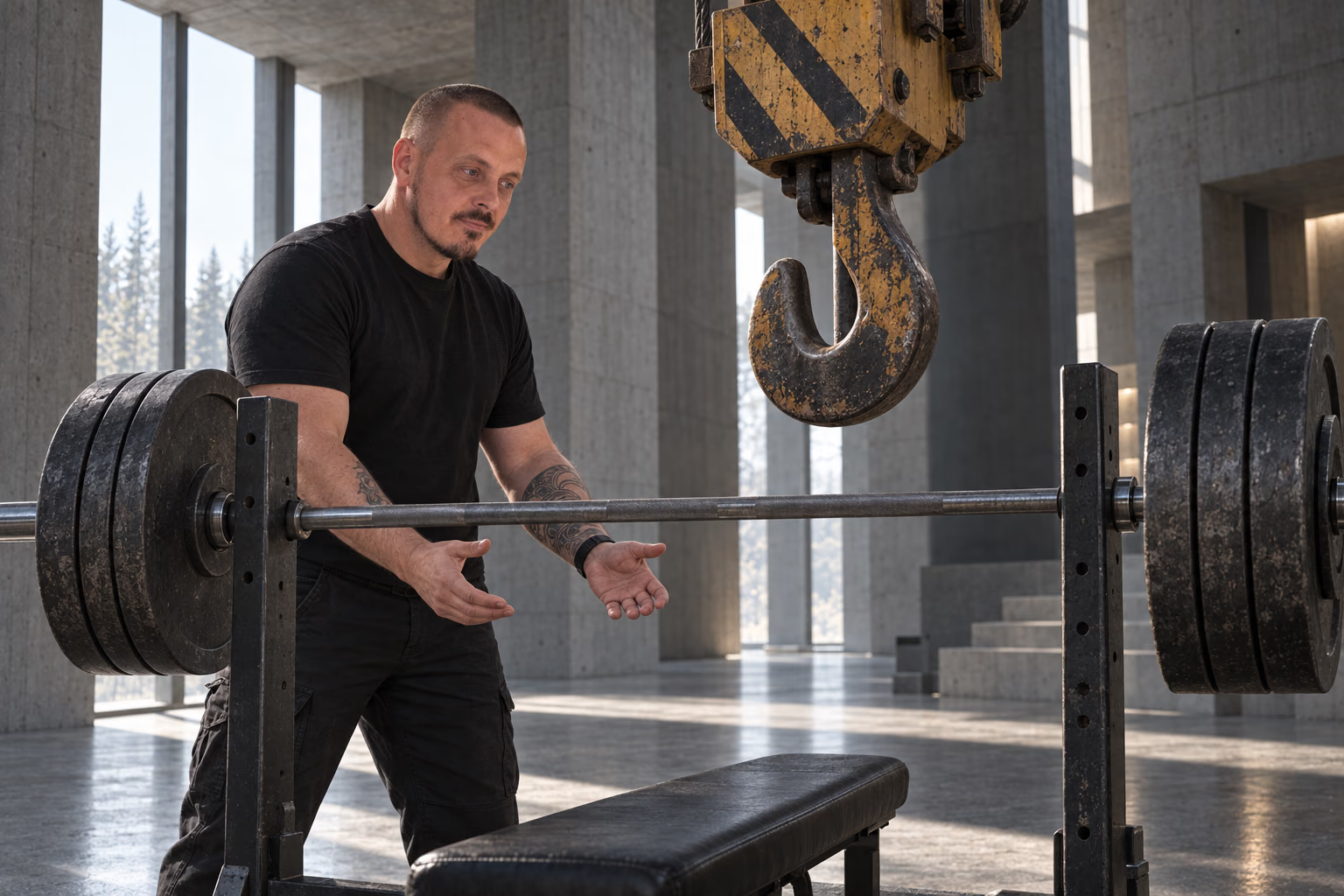
Picture a bench in a gym. Someone is lying beneath a heavy barbell held over their chest. Behind the bench stands a spotter with hands close to the bar. The spotter follows the lift, steps in if something goes wrong and may provide exactly the small amount of help that makes the final repetition possible.
Now place a crane beside the bench. It can lift far more than either the person or the spotter. If the aim is to move the barbell from the floor to a rack, the crane is the best tool. If the aim is to train the body, it is useless. The bar moves, but the muscle learns nothing.
It is tempting to judge AI by how much it can lift for us. How quickly can it write the report, solve the calculation, make the training programme or compose the message after an argument? Those are relevant measures when we want a result. They become misleading when the result of the work was also supposed to be a change in us.
It is important here not to end up defending difficulty for its own sake. Most of us use a calculator without worrying that our mental arithmetic is becoming rusty. With a calculator, we can solve larger problems than we could without it. A telescope does not sharpen the eye, but it makes the universe larger. An excavator does not develop our back muscles, but it can move an amount of earth that would otherwise make the project impossible.
Researchers call it cognitive offloading when we change a task by placing some of the work outside the mind. A calendar remembers the meeting. Paper holds the intermediate calculation. The phone shows the way. Humans become more dependent on their tools and capable of more at the same time. That is not a contradiction. It is a large part of the history of civilisation.
The test therefore cannot be whether we become better at managing without AI. That would be like criticising the crane for failing to make a construction worker capable of lifting a concrete beam alone. The question must come before the choice of assistance: Are we building a house, or training a muscle?
The strange price of comfort
In The Comfort Crisis, Michael Easter begins with a simple observation. Large parts of modern life are designed to keep us fed, at a comfortable temperature and free from physical discomfort. He goes on a 33-day hunting expedition in Alaska and uses it as a route into research and stories about what happens to people when we are rarely challenged.
The book should not be read as proof that all discomfort is healthy. A bad office chair does not automatically make your back stronger. Overwork does not make a workplace wiser, and a destructive relationship does not become valuable because it is difficult. There is a difference between a strain the body can adapt to and one that merely wears it down.
That distinction exists all the way down in biology. The concept of hormesis describes a dose response in which a moderate and often intermittent exposure can trigger a beneficial adaptation, while a larger dose inhibits or harms. Exercise works by placing enough strain on the body for it to rebuild. The same weight without rest, technique or the possibility of recovery can cause injury.
Nassim Nicholas Taleb describes a related mechanism with the antifragile. Something fragile breaks under disturbance. Something robust can withstand it. The antifragile improves through an appropriate amount of variation and stress.
That does not mean a person as a whole improves through every adversity. We should be wary of the romantic claim that whatever does not kill us makes us stronger. Some experiences leave people ill or afraid for the rest of their lives. Antifragility only makes sense when we are talking about a particular capacity, a particular stressor and a range within which adaptation is actually possible.
But within that range, something happens that is easy to overlook when we design technology: The apparent obstacle may be the exercise itself.
When struggle is part of learning
This is easy to recognise in education. A student may watch a teacher solve ten maths problems and feel that everything makes sense. Only when the student sits alone with the eleventh does it become clear whether the understanding has actually become their own.
At UCLA, the Bjork Learning and Forgetting Lab studies what researchers call desirable difficulties: forms of learning that make practice harder in the moment but improve retention later. Retrieving an answer from memory may feel slower than reading it again. Mixing different kinds of problems may feel messier than repeating the same type. Yet that very effort can produce stronger learning.
A difficulty is only desirable if it can be overcome. If the intervals between exercises become too long, or the student lacks the necessary foundations, the resistance is no longer productive. It simply blocks the way.
The same pattern appears in research on productive failure. A meta-analysis of 53 studies found an overall advantage in allowing students to try to solve a new problem before receiving instruction, rather than giving instruction first. The advantage did not apply equally across all groups and types of tasks. The point is not that the teacher should withhold help. It is that the timing and form of help change what the student learns.
That makes AI’s role far more interesting than a choice between unrestricted access and prohibition. A model can produce the answer in seconds, but it can also observe the attempt, notice the misunderstanding and offer a small nudge without taking over the rest. It can ask an easier question after a failure and make the next task harder when the answer came too easily. Because it can adapt to an individual from moment to moment, it could in principle become an unusually precise spotter.
It only requires that we ask it to optimise for learning rather than immediate performance. The two look alike on the screen because both may end in the correct answer. Inside the person, the difference is enormous.
The relational muscle
Relationships are more difficult because there is no correct answer, and because another person is not an exercise we have the right to dose. Even so, the distinction between the crane and the spotter fits uncomfortably well.
After an argument, AI can help us see the situation from the other person’s point of view. It can question our own account, identify a pattern and help formulate the opening sentence of a conversation we do not know how to begin. It can also provide so much comfort and affirmation that it becomes easier never to have that conversation.
This is not a small field of possibility. Common Sense Media found in 2025 that nearly three out of four American teenagers had tried AI companions. One third had chosen an AI over a human for a serious conversation. That does not tell us in itself whether relationships are becoming worse, but it shows that the question no longer belongs only to science fiction.
A four-week study involving 981 participants found no significant effect from the conversation modes or voices to which participants were randomly assigned on outcomes including loneliness, social interaction and emotional dependence. Participants who voluntarily used the chatbot more tended to have worse outcomes, but the study cannot determine whether the use caused the problems or whether people with problems were more likely to seek out the chatbot.
So we do not know whether a relational muscle is already atrophying. It remains a possibility, not an established effect. But the distinction between the human being and the machine is worth holding on to.
A chatbot can imitate resistance. It can be instructed to challenge us, say no or point out a contradiction. But its needs are still part of the service it provides to me. When it makes the conversation difficult, it does so for my sake. Another person’s resistance comes from somewhere else. A friend may need something other than what I want to give. She may grow tired of me, insist on her own interpretation and walk away.
If I learn to handle that, I am not merely receiving a more troublesome version of the support AI could have provided. I am learning to share the world with another centre besides myself. That is not friction around a relationship. It is part of what a relationship is.
AI can certainly help. It can make me better prepared, more attentive and less trapped in my own perspective. But if it is to work as a spotter, at some point it has to release the bar and send me back to the person I cannot prompt into becoming different.
Hands beneath the bar
We have long used technology to remove resistance. It has spared us physical wear and made us capable of things no single body or mind could manage alone. AI carries that movement into thought, judgement and companionship.
There are burdens that do not deserve to be preserved simply because earlier generations had to carry them. But when we remove a challenge, we should know whether we have removed an obstacle or the training itself.
That cannot be decided once and for all. The same AI can be a crane when a report needs to be finished and a spotter when a new employee needs to learn how to understand it. It can write the message or hold back if the aim is for me to work out what I want to say.
Today we measure AI by how quickly it answers, how large a problem it can solve and how many human steps it can remove. The spotter’s work is successful when the other person becomes capable of carrying more.
We have built a machine that can lift the bar almost every time. The next task is to teach it when its hands should only hover just beneath it.