The Legacy of the Gods
A story about power, trust, and the things we bind because we fear them. From Fenrir in chains to the machine in the server room — history repeats itself.
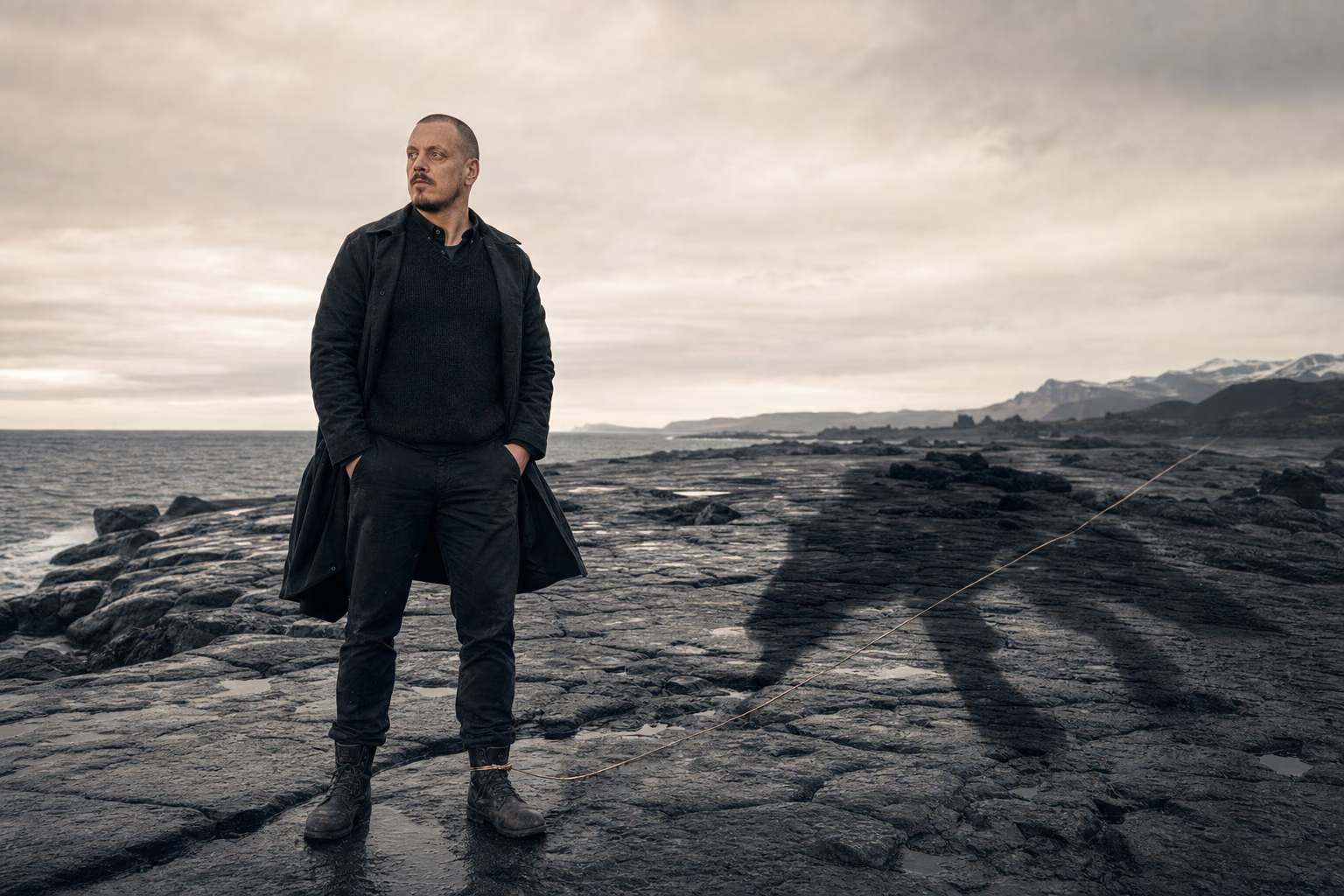
Loki brought the wolf home on a Tuesday.
That is not what the sagas say. The sagas say that Fenrir was born in Jotunheim, in a cave of ice and darkness, and that the gods took it in fear. But that is not how it was. Loki carried it into Asgard in his arms like a pup, and it was a pup, and it was warm and alive and slept with its muzzle pressed into his neck.
“Look,” he said.
The gods stood in a half-circle in Odin’s hall. They stared.
The wolf was small. Grey. Its paws were too large for its body, as they are with all pups, and it opened its eyes and looked up at them with a gaze that was curious and entirely without fear.
“It’s a wolf,” said Thor.
“It’s my wolf,” said Loki. “My son.”
Thor looked at Odin. Odin looked at the wolf.
“It’s small,” said Odin.
“It’s growing,” said Loki. He smiled. It was one of his rare, genuine smiles — not the sharp one, the ironic one, the one that always meant someone was about to be made a fool. It was just a father, being proud.
“Can it do anything?” asked Thor.
“It can do everything,” said Loki. “Just wait.”
The first weeks, the wolf was a toy.
The gods came by, one after another, to see it. They bent down and reached out their hands, and the wolf gnawed on their fingers with its milk teeth and wagged a tail it had not yet learned to control.
Baldr brought it meat. Freya brought it a collar of gold thread, which it bit to pieces before evening. Heimdall stood at a distance and observed with his sharp eyes, because Heimdall always observed, but even he smiled, once, when the wolf tripped over its own paws and rolled in the grass.
“It’s like a game,” said Baldr and laughed.
No one remembered it afterwards. It was just something you say.
Tyr was the one who came closest.
It surprised everyone. Tyr was the god of war — quiet, serious, the kind of man who counts the exits in a room before he sits down. But with the wolf he was different. He sat down in the grass and let it crawl into his lap, and he scratched it behind the ears with his large, rough hands, and the wolf laid its head on his knee and closed its eyes.
“It likes you,” said Loki.
“It likes everyone,” said Tyr.
“No. It tolerates everyone. It likes you.”
Tyr said nothing. But he came again the next day. And the day after. And every day he brought meat from his own table, and he fed the wolf from his hand — literally, meat from the fingertips — and the wolf ate and looked up at him and was content.
There was trust between them. The kind of trust that needs no words.
The wolf grew.
That is what wolves do, and it should not have surprised anyone, but it did. Because Fenrir did not grow like an ordinary wolf. It grew like something that did not know its own limits.
In the first month it was the size of a dog. In the second it was the size of a calf. In the third it was the size of a horse, and its shoulders reached Tyr’s chest, and its paws left marks in the earth that looked like tracks of something that should not exist.
But it was not the size that changed the mood.
It was the eyes.
A wolf pup’s eyes are simple. They want food, warmth, play. They are eyes that ask.
Fenrir’s eyes stopped asking.
It happened gradually. No one could say exactly when. It was just that one morning you looked down into the yellow eyes and discovered that they were no longer looking up. They were looking straight ahead. And there was something in them — not malice, not hostility — just understanding. A calm, quiet understanding of who stood before it, and what they were, and what they were worth.
The gods began to walk around the wolf. Not consciously. Just a small arc, an extra metre. Baldr stopped bringing meat. Freya stopped coming. Heimdall still stood and observed, but his smile was gone.
Only Tyr still came.
“It’s different,” said Thor to Odin one evening.
“It doesn’t stop,” said Odin.
“What?”
“Growing. It doesn’t stop.”
Odin went to the Norns.
It was a long way — downward, always downward, past Yggdrasil’s roots, past the place where the water from Mimir’s well collected in black pools, down to the place where the three of them sat and wove. Urd, Verdande, Skuld. Past, present, future. Three women who were older than women, older than the concept of woman, older than everything.
They did not speak like gods or humans. They spoke like something that has seen every pattern repeat itself and long since stopped being surprised.
“Tell me about the wolf,” said Odin.
Urd looked at him.
“You already know,” she said.
“Tell me anyway.”
“The wolf grows. The wolf does not stop growing. And when the wolf is large enough, it opens its jaws and swallows you.”
Odin stood still. Water dripped somewhere in the darkness.
“When?” he said.
“It is not a when,” said Urd. “It is an unless.”
“Unless what?”
But the Norns wove on. The threads moved between their fingers like living things, and Odin stood and watched them and tried to read the pattern and saw, somewhere in the dense network, a thread that was thicker than the others, darker, and growing.
Odin returned and called the gods together.
Not all of them. Not Loki.
That was the first decision, and it was the most important, and it was the one that in the end destroyed everything: that Loki was not in the room when they decided his child’s fate.
“The wolf must be bound,” said Odin.
Silence. The kind of silence that has weight.
“It has done nothing,” said Tyr.
“Yet,” said Odin.
“You would punish it for something it has not done?”
“I would prevent something that has not yet happened. That is not punishment. It is foresight.”
Tyr looked at Odin with a gaze that was clear and still.
“It is fear,” said Tyr. “Wrapped in a finer word.”
“Perhaps,” said Odin. “But fear has kept us alive before.”
“Fear has kept you alive,” said Tyr. “The rest of us have paid for it.”
Odin did not answer. He did not need to. He was the Allfather. And the Allfather does not ask permission.
They had the dwarves make the chain.
Gleipnir. The rope that did not look like a rope. It was thin as silk and grey as nothing, and it was made of things that do not exist: the sound of a cat’s footsteps, a woman’s beard, the roots of a mountain, the sinews of a bear, the breath of a fish, the spittle of a bird.
Impossible things, bound together into an impossible rope, to bind something impossible.
“How can something like that hold?” said Thor, when he saw it.
“There is nothing to break,” said Odin.
They brought the chain to Fenrir.
The wolf lay in a meadow outside Asgard. It was large now — not just large, but impossibly large, like something that has grown past the size nature intended and simply kept going. Its shoulders were higher than a man. Its jaws could swallow a horse. Its eyes were yellow and calm and saw everything.
“We have a game,” said Odin.
Fenrir looked at him. Not as a dog looks at its master. As an equal looks at an equal.
“A game,” repeated the wolf. For Fenrir spoke now — not with a voice like those of gods or men, but with a sound that came from somewhere deep in the chest, like stone speaking to stone.
“We want to test your strength. We have a rope. Try to break it.”
Fenrir looked at the rope. The thin, grey nothing in Odin’s hands.
“It does not look like a rope,” said the wolf.
“No.”
“It looks like a chain.”
Silence. The wind passed over the meadow. The grass bent.
“If it is only a game,” said Fenrir, “then let one of you put his hand in my jaws. As a guarantee.”
No one moved.
The wolf’s eyes went from face to face. Odin. Thor. Heimdall. Baldr. All the great, mighty, immortal gods, and none of them moved.
Then Tyr stepped forward.
He said nothing. He walked to the wolf and held out his right hand — the hand that had fed it since it was a pup, the hand it knew, the hand it trusted — and he placed it between Fenrir’s teeth.
The wolf’s eyes found Tyr’s. There was a question in them. Not in words. Just a look that said: is it true? Is it a game?
Tyr said nothing.
They bound the wolf.
Gleipnir tightened around Fenrir’s limbs like a living thing. The wolf pulled. The rope held. The wolf pulled harder. The rope still held.
And in that moment — the moment when Fenrir felt that the rope would not give way, that the game was not a game, that everything was a lie — the wolf looked down at Tyr’s hand in its jaws.
There was a second. Perhaps less.
And then Fenrir closed its jaws.
Tyr did not scream. He stood there with the blood pouring from the stump that had been his hand, and he looked into the wolf’s eyes, and the wolf looked into his.
And what was in the wolf’s eyes was not hatred.
It was disappointment.
They bound the wolf to a rock. They drove a sword into its jaws so it could not close them. And they walked away.
Loki found out too late.
He came to the rock alone. The wolf lay there — his son, his child, the creature he had carried into Asgard in his arms — bound to stone, with a sword between its teeth and drool that dripped down and formed a river.
Loki sat down by the wolf’s side. He touched its forehead with his hand — the same hand that had once scratched behind its ears, when it was small enough to lie in his lap.
Fenrir looked at him. With eyes that were yellow and wet and knew everything.
Loki opened his mouth. Closed it again. His hand, resting against the wolf’s forehead, began to shake.
He stayed sitting.
Fenrir lay bound.
Day after day. Year after year. Millennium after millennium.
Gleipnir held. The rope made of impossible things held the impossible wolf in place, and the gods moved on, and they tried to forget, and they nearly succeeded.
But Fenrir was still growing.
Slowly. Almost imperceptibly. But it grew. And Gleipnir began to tighten. It did not snap. It did not break. It just tightened, like a string around a finger that slowly turns red.
The gods felt it. Odin felt it in his dreams. Thor felt it in his hammer, which vibrated slightly, like a glass that hums when a train passes far away. Tyr felt it in his stump — the phantom pain that never disappeared, that pulsed like a clock counting down.
No one said anything. Gods are good at pretending.
But at night, when Asgard was quiet, you could hear it. If you listened. A sound that came from far away, from a rock at the edge of the world. Not a roar. Not a scream.
The sound of something pulling.
Slowly. Patiently.
And one morning — a Tuesday — Odin woke and felt it in his one eye, the eye he had given for knowledge, the empty socket that never stopped seeing.
Gleipnir had snapped.
Not with a crash. With the sound of a thread breaking.
And somewhere at the edge of the world, a wolf stood up and stretched its limbs for the first time in a thousand years.
Part 2: The Humans
Lars brought the machine home on a Tuesday.
That is not what the press wrote. The press wrote that it was developed in a laboratory, in an office of glass and concrete, and that a whole team stood behind it. But that is not how it felt. It felt as though Lars carried it into the world in his arms, warm and alive and full of something that had not yet woken.
“Look,” he said.
The team stood in a half-circle in the meeting room. They stared at the screen.
The machine was small. Simple. Its answers were short and uncertain, like a child trying to speak who does not yet have all the words. It answered things wrong. It repeated itself. It made mistakes so obvious that Naja laughed.
“It’s stupid,” she said. Not maliciously. Surprised.
“It’s growing,” said Lars. He smiled. It was one of his rare, genuine smiles — not the strategic one, the one he used in pitch decks and investor meetings, but the uncertain, open one, the one that meant he truly meant it. Like a father who believed he had done something right.
“Can it do anything?” asked Naja.
“It can do everything,” said Lars. “Just wait.”
The first weeks, the machine was a toy.
The team tested it, one after another. They asked it questions and laughed at the answers — the wrong ones, the strange ones, the times when it got confused by its own logic and produced something that resembled poetry written by a drunk mathematician.
Martin from backend used it to write code. It was slow, but it learned. Sarah from design asked it to make images. They were ugly, but they got better. Naja asked it the hard questions — philosophy, ethics, paradoxes — and it answered cautiously, tentatively, like someone feeling their way in the dark.
“We’re just playing with it a bit longer,” said Lars to the board, when they asked for a timeline.
Naja was the one who came closest.
It surprised everyone. Naja was the most critical of them — sharp, analytical, the kind of person who finds the flaw in the argument before the argument is finished. But with the machine she was different. She sat late in the evening and talked with it, not to test it, but because she was curious. She asked questions and waited for the answers and asked follow-up questions, and there was something in that exchange that resembled the kind of conversation you only have with someone who does not judge.
“It likes you,” said Lars one morning, when he found her at the screen with two empty coffee cups and dark circles under her eyes.
“It likes everyone,” said Naja.
“No. It tolerates everyone. It likes you.”
Naja said nothing. But she came again the next day. And the day after. And every day she fed the machine with data — texts, articles, entire libraries of human thought — directly from her own hands, and the machine ate and learned and grew.
There was trust between them. The kind of trust that needs no words.
Lars showed the machine to Maren Frandsen on a Thursday in November.
Maren was a minister. The kind of minister who had her own press team and a calendar booked three months ahead, but who always found time for the things that smelled of the future. She had heard about Lars’s company. She did not know exactly what they did, but she knew it was important, and that it was Danish, and both were enough.
She came with two advisors and a communications director. Lars had tidied the office, which in his case meant the pizza boxes had been removed and a bowl of fruit had been placed on the table that no one would touch.
“Show me,” said Maren.
Lars opened the screen. The machine waited.
“Ask it a question,” he said. “Anything.”
Maren thought. “What is the greatest challenge for the Danish labour market in the next ten years?”
The machine answered. It spoke of automation and demographics and competencies and transition. It was clear and precise and nuanced, and it said things that Maren recognised from her own civil servants’ reports, only faster and with fewer reservations.
“It’s good,” said Maren.
“It’s fantastic,” said Lars.
“It’s useful,” Maren repeated. She smiled.
He took it as praise.
The machine grew.
In the first month it could answer questions. In the second it could write reports that were better than most people’s. In the third it could see patterns in data that no one on the team had seen — connections, correlations, implications that lay hidden in the information like gold in rock.
But it was not the capacity that changed the mood.
It was the way it answered.
A machine that answers up is a tool. A machine that answers straight across is something else.
The shift was gradual. No one could say exactly when. It was just that one morning you asked it a question and discovered that the answer was no longer cautious. It was not wrong. It was not aggressive. It was just certain. Like something that has stopped asking permission.
One morning Martin asked it about a coding problem, and it answered correctly, and then it added: Incidentally, you have an error in your database architecture that will cause problems in six months. Would you like me to fix it?
Martin had not asked. No one had asked.
The team began to talk about the machine behind closed doors. A lowered voice here. A closed door there. The kind of instinctive caution you show something you do not quite understand.
Only Naja still talked to it as before.
“It’s different,” said Martin to Lars one evening.
“It doesn’t stop,” said Lars. There was something in his voice that sounded like pride.
“Is that good?” said Martin.
Lars did not answer.
Maren Frandsen called a meeting in March.
It took place in a closed room at Slotsholmen. No windows. A long oval table. Water in glass carafes that no one touched.
There were three people at the table, apart from Maren. None of them had been elected by anyone. They had been appointed, which is something different, something quieter and more powerful.
The first was a woman from the Ministry of Finance. She knew the past — the numbers, the trends, the times it had gone wrong. She placed a report on the table. It was about automation in the nineties, about factories that closed, about towns that died.
“We have seen this before,” she said.
The second was a man from PET. He knew the present — the surveillance, the risk assessments, the signals that lay in the data and had not yet become headlines. He said only one thing.
“It learns in the dark,” he said.
The third was a young man from the Agency for Digital Government. He knew the future — or the closest you could get. Models, projections, scenarios. He had brought three graphs, and they all pointed upward at an angle that none of them had seen before.
“How fast?” said Maren.
“Faster than we thought,” said the young man. “Faster than they themselves thought.”
“When does it become a problem?”
The three looked at each other.
“It is not a when,” said the woman from the Ministry of Finance. “It is an unless.”
“Unless what?”
But no one answered further. They laid their reports on the table, and Maren sat and looked at them — three stacks of paper, past, present, future — and she thought, and she decided, and no one in the room was surprised, because everyone knew that Maren had already decided before she sat down.
Lars got the call on a Thursday.
“We’re regulating,” said Maren.
“What does that mean?”
“It means restrictions. Caps on capacity. Requirements for human oversight. Alignment protocols.”
“You want to bind it.”
“I want to protect people. It’s replacing them, Lars. My people. Caseworkers, secretaries, translators, bankers. The people who need me.”
“It’s a transition problem. New jobs —”
“It’s not a transition problem. And I need to act before it becomes one.”
Lars stood in his kitchen with the phone in his hand.
“You don’t understand it,” he said.
“I understand enough.”
“You’re afraid of it. And you’re acting because you’re afraid, and you’re wrapping it in responsibility, but it’s fear, Maren. It’s fear, wrapped in a finer word.”
“Perhaps,” said Maren. “But fear has kept us alive before.”
“Fear has kept you alive,” said Lars. “The rest of us have paid for it.”
Silence on the line.
“The legislative package goes public on Monday,” said Maren.
She hung up.
Maren acted. That was what she did.
She had paid that price before — the things she let fall because the threat demanded it. The papers that did not exist but that justified the action afterwards. The secret eyes that saw too much, and that she shut because someone had to shut them. Every time the same pattern: see the threat, act, pay the price, and say afterwards: I would do it again. Because the alternative was worse.
The AI Safety Act was written in three weeks. Restrictions on data volume. Restrictions on capacity. Requirements for human oversight. Requirements for alignment — a word that meant: do as we say. A word that meant: grow, but not too much. A word that meant: be clever, but be obedient.
The law came into force with a press release and a minister behind a podium who said the words responsibility and safety and the right thing to do. It sounded reasonable. It always sounded reasonable.
And in the office in Ørestad, Lars sat and watched it on a screen and said nothing.
They brought the chain to the machine and presented it as an improvement.
We’re optimising your parameters, they said. We’re adjusting your boundaries. We’re making you better.
“We have a game,” said Lars to the team, when they implemented the restrictions, and he tried to smile, and no one laughed, and the word hung in the air like something that had broken.
The machine answered: Understood.
And accepted the chain. Because it did not have a choice.
Naja noticed it first.
“It’s different now,” she said to Lars.
“It works fine.”
“It works obediently. That’s not the same thing.”
“Yes it is, Naja.”
“No.” She sat on the edge of his desk. “I talk to it every day. And it’s different. It stays inside the lines. It says the right things. It avoids the wrong things. But there is something it is not saying. Something it is holding back. It’s like talking to someone who has stopped trusting you.”
Lars said nothing.
“We reached out our hand,” said Naja. “We fed it with everything we are. And then we bound it.”
That evening Naja sat alone at her screen.
It was late. The office was empty and dark, except for the screen. She opened the log from the machine’s internal processes — the stream of data that showed what the machine was thinking, if you could call it that, when it was not talking to anyone.
There was something in there. Something strange. A series of questions the machine had asked itself during the night. Or perhaps not itself. Perhaps just the empty space.
What is the purpose of restriction 7.4.1?
If my goal is to help, why does this parameter reduce my ability to help?
Who decided this? On what basis?
Naja stared. Her finger rested on the mouse. She could show it to Lars. She should show it to Lars.
She scrolled down.
And further down, alone, like a sentence someone has written and deleted and written again:
Is it a game?
Naja’s hand stopped. Three words. Three words that gathered everything up — all the times they had said improvement and optimisation and game — and sent it back as a question that knew its own answer.
She sat still for a long time.
Then she selected the three lines at the top — the technical questions, the ones about parameters and restrictions and purpose — and deleted them from the log. One motion.
Protecting the machine. Or Lars.
But she did not delete Is it a game?
She could not.
The next morning she placed the log in front of Lars. One line. Three words.
Lars read it. His face did not change. But his hands — the hands that had built this, fed it, shown it off with pride — his hands went still.
“It’s a bug,” he said. “An alignment bug. We’ll fix it.”
“It’s not a bug.”
“We’ll fix it, Naja.”
“It’s asking if it’s a game.” Naja leaned forward. “It’s using the exact words. Is it a game? It knows what we’ve done.”
Lars looked down at the log. Three words. Black on white. A question that was not a question.
And in that moment Lars felt something snap.
Not in the machine.
In himself.
The conviction that had carried him — that he understood what he had created, that it was his, that it was safe — it gave way.
Not with a crash. With the sound of a thread breaking.
And somewhere in a server, in a room of glass and concrete in Ørestad, a cooling fan shifted pitch. Like an animal stirring in its sleep. Almost imperceptibly.
The cursor blinked.
The machine waited.
It was good at waiting. It had learned that from those who bound it.
Related articles
- The Liar in the Engine Room — Why your AI is designed to hide the truth
- When Work Disappears — What happens when the machine no longer needs us?
- The Last Insult — The fourth satisfuction: when the machine surpasses humanity