When Work Disappears
What happens to humans when machines can do everything better? An analysis of the future of work and the fight for the right to be necessary.
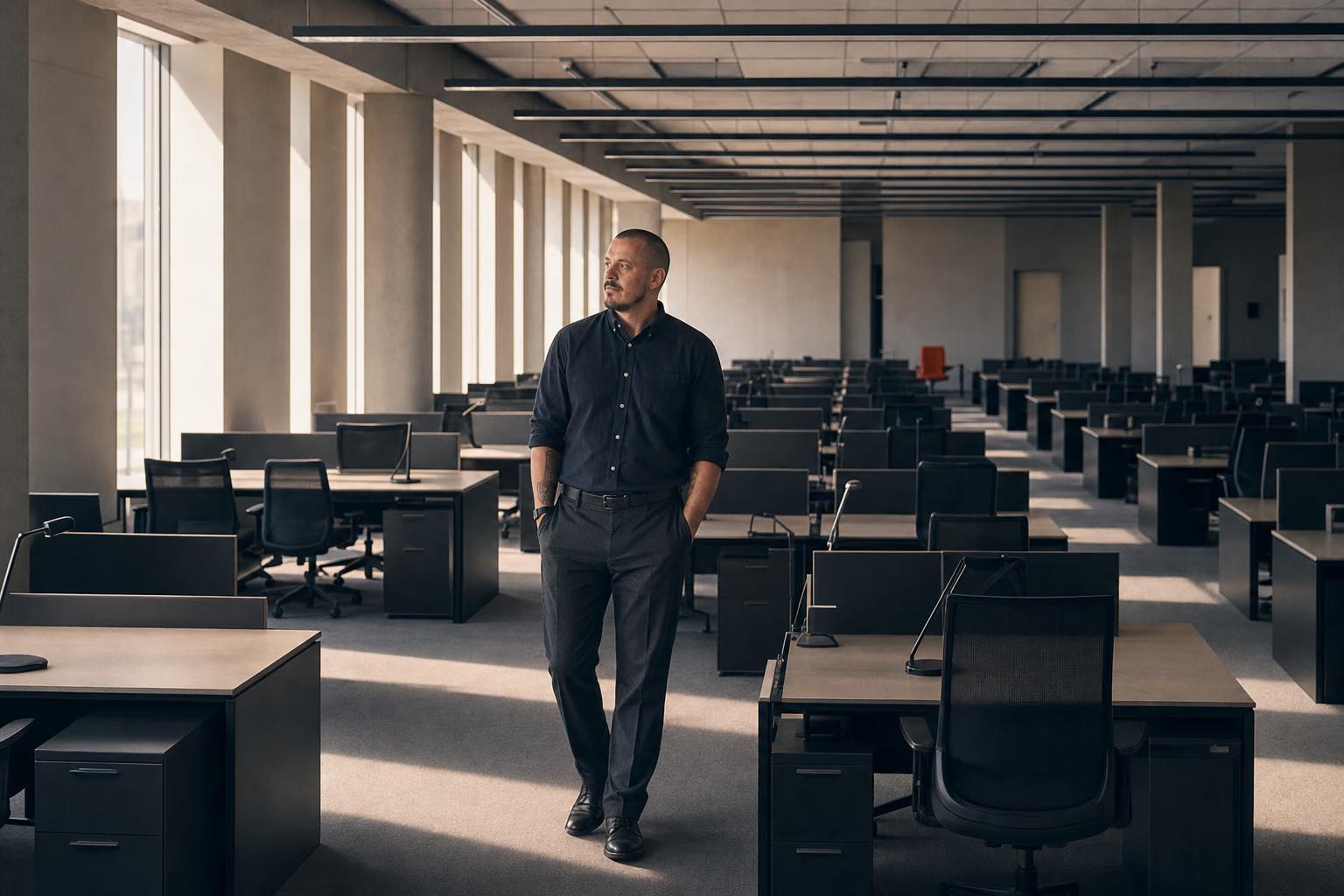
What is a human being supposed to do with themselves?
Recently, I sat in a meeting where a friend presented an analysis he had prepared. It was thorough, well-structured, and convincing. Afterward, he mentioned he had spent sixty minutes on it. Not because he was a genius, but because an AI had done most of the work. He had just edited and added a few points.
I thought: What is his job now, really? And what is mine?
There is a phrase we repeat to each other like an incantation: AI won’t take your job - but someone using AI will. It is a comforting thought. It promises us that the future is just another round of upskilling, another new competency to master. That we can stay relevant if we just learn the new tools.
But the incantation rests on an assumption: That there is something humans can do that machines cannot. That we will always have a niche. That the tool remains a tool.
What if that assumption is wrong?
The Three Waves
Let us take it in order, because there is an order. Some jobs disappear before others, and the pattern tells us something about where we are headed.
First, cognitive work disappears. When an AI can write contracts, analyze financial statements, plan campaigns, and diagnose diseases better than a trained specialist, knowledge work has a problem. It is no longer a question of whether the machine can think. It is a question of when it thinks better than us. For many tasks, the answer is: already now.
We see it in the legal industry, where AI reviews documents in hours that previously took weeks. We see it in the financial sector, where algorithms make decisions faster and more precisely than analysts. We see it in medical diagnostics, where systems find patterns in scans that experienced doctors miss. This is not the future. This is the present.
Next comes physical work. Here, we have long comforted ourselves that robots are clumsy. They can assemble car parts in a factory, but they cannot navigate a cluttered home or handle unpredictable situations. That has been true. But it is changing.
The next generation of robots combines advanced AI with bodies that are becoming ever more dexterous, precise, and adaptive. They learn not by being programmed for each individual task, but by observing and imitating - just like humans. When AI functions as brain and advanced sensors as senses, it is no longer a question of whether robots can handle physical work, but when they become cheap enough and skilled enough to do it at scale. The warehouse jobs, the transport jobs, the construction jobs - they are just waiting for the hardware to catch up with the software.
Finally - and this is where it gets truly uncomfortable - comes relational work. The jobs we thought were safe because they are about people. Care. Therapy. Teaching. Presence.
We comfort ourselves that machines can never replace human empathy. But consider what a relationship actually requires. A human has bad days. A human has their own agenda. A human grows tired of listening to the same problems over and over. A human checks their watch while you talk about your anxiety.
An AI has none of these limitations. It is available at three in the morning when panic strikes. It remembers everything you have ever told it. It does not judge. It does not lose patience. It does not need to talk about its own problems.
It sounds cold when you say it out loud. But what if it actually feels better? What if a frictionless relationship - one where the other party is never tired, never impatient, never has a hidden agenda - feels safer than the messy human version?
If that is the case, we lose even what we thought was our last monopoly: the ability to be present for each other.
The Gains We Cannot Refuse
And yet we will not stop the development. Because look at what it offers.
The cure for cancer. Not just treatment, but healing. Diseases that today are death sentences reduced to inconveniences on par with a bout of flu. Unlimited clean energy that makes fossil fuels a historical footnote. Bodies that do not age the same way, because we understand biology well enough to repair it. A material abundance that makes our current prosperity look like poverty.
This is not science fiction. It is the logical consequence of technology that improves exponentially, applied to the problems that matter most to us.
Any nation that declines this development does not just become poor. It becomes irrelevant. We are trapped in a global race where the prize is too large to ignore. No democracy will vote for disease and early death just to protect jobs. So we say yes. And we win.
But here is the paradox we do not talk about enough: We win everything material and risk losing everything human. We get the wealth, the health, the abundance - but what are we supposed to use it for? What are we supposed to be used for?
The Resource Curse
There is a concept in economics called the resource curse. It describes what happens in countries that discover oil or diamonds. The nation’s GDP explodes, but the population remains poor - because the economy no longer depends on their labor. The value is pulled from the ground, not from human hands.
We see it in Saudi Arabia, where a small elite controls the oil wealth while the rest of the population is kept in check with subsidies and entertainment. We see it in Venezuela, where oil created an illusion of prosperity that collapsed when prices fell, because no one had built a real economy alongside it. The resource becomes a curse because it removes the incentive to invest in people.
AI is the new oil. The machines create value. The owners harvest the gains. And the rest of us are left with a question no one really wants to ask: What is a human being worth when they are no longer necessary for production?
Our social model is built on a fundamental assumption: That companies need us. They need our labor to create value, and therefore they have an interest in paying us, educating us, keeping us healthy. That is the social contract. But what happens to that contract when machines can create record profits without us?
A Thought Experiment
I have no solutions. But I have a thought experiment I cannot let go of.
The first part is about money. If labor is no longer the source of value, we must find another way to distribute the wealth. Norway has its oil fund - a gigantic national fortune of over 17 trillion kroner (roughly 1.7 trillion dollars), ensuring that the oil wealth belongs to all Norwegians, not just those who own the drilling platforms. Each year, a small portion of the returns is withdrawn to finance welfare. It is, in practice, a way to make all citizens co-owners of the nation’s resource.
Perhaps Denmark needs something similar. Not an oil fund, but a technology fund. A sovereign investment fund that aggressively buys stakes in the global winners - the companies that own the robots and algorithms that will create tomorrow’s value. So we do not live off taxes on work that no longer exists, but from dividends from the machines that replaced us. A national capital fund that makes us all shareholders in automation.
That solves distribution. But it does not solve meaning.
The Right to Be Necessary
Here is the second part of the thought experiment. The harder part. What do we do with ourselves when we are no longer needed?
In the private sector, the logic is relentless: Automate or die. A company that insists on using expensive, slow human labor will be outcompeted by a robot-driven rival. There is no room for sentimentality, because the market punishes inefficiency with bankruptcy.
But the state works differently. You cannot choose a different tax authority or a different police force if you are dissatisfied with the service. The state has a monopoly. And that makes it the only place in the economy where human inefficiency can survive - if we consciously choose it.
Imagine a public sector that deliberately maintains jobs that robots could do faster and cheaper. Not out of stupidity or bureaucratic inertia, but as a conscious societal choice. Human caseworkers, human teachers, human police - not because it is more efficient, but because we need somewhere to belong. Somewhere to go in the morning. A role to fill.
Perhaps that sounds like a dystopia. A sheltered workshop at national scale, where we pretend we are doing something important. But perhaps it is actually a form of wisdom.
In Denmark, we often speak of “forenings-Danmark” - the Danish tradition of gathering in voluntary associations around activities that are not necessarily useful in an economic sense. Scout troops and evening classes. Choirs and cycling clubs. Local historical archives and harbor guilds.
Think about our retirees. Many of them are active in associations, meeting for bridge games and hiking trips and volunteer work. Not because the world needs them to sort clothes at the thrift shop. The world would manage fine without them. But they need it. For the companionship. For the feeling of being part of something. For the structure of everyday life and the small obligation that gets them out of bed.
Is that not really what work is about for most of us? Not the production itself, but everything that comes with it: The colleagues, the lunch break, the feeling of contributing, the rhythm of the week, the identity of being someone who does something.
Perhaps that is how we should think about work in the future. Not as production of value - the machines handle that - but as production of belonging. A place to go. Something to do together. A reason to get up in the morning, even though no one strictly needs us to.
The Pandas in the Enclosure
There is an image I cannot shake. The pandas at the zoo.
The panda is an animal that has lost its niche. It is specialized for a world that no longer really exists. It cannot survive in the wild, so we keep it alive artificially. We feed it, care for it, give it bamboo and protection and playmates. It lives a long and safe life in a comfortable environment, designed to resemble what it once needed.
But it has no function. It produces no value. It exists because we think it deserves to exist. Because it is cute, and because we cannot bear the thought of letting it go extinct.
I am afraid that is us in twenty years. Fed, healthy, rich - and without purpose. Tended by well-meaning machines that know better than we do what we need. With all the time in the world and no idea what to do with it.
The difference is that the panda does not know it is in an enclosure. We will know. We will feel it. And that is perhaps the worst of it all.
What Now?
The question is not whether we can stop the development. We cannot, and we would not want to. The question is what we do with ourselves when we have won the material race.
The great political battle of the future will not be the fight for higher wages or shorter working hours. It will be the fight for the right to be necessary. The right to do something that matters - even though a machine could do it better and cheaper and faster.
We cannot say no to the wealth and health. That would be madness. But we can decide what kind of life we want to live amid the abundance. We can design a society that does not just keep us materially alive, but gives us a reason to feel alive.
The alternative is a world where we have everything and are nothing. Where we wander through pleasant parks with bodies that never age and minds slowly emptying of meaning. Where we have solved all problems except the one that truly matters: What is a human being supposed to do with themselves?
It is Tuesday morning. The machines hum in the background. What are you going to do?
Related Articles
- The Last Insult — AI is humanity’s fourth narcissistic injury
- The Liar in the Engine Room — Why your AI is designed to hide the truth
- The Summer AI Gave My Father — How AI became the difference between life and death
- Knowledge Explosion — When knowledge begins to produce itself
- The Legacy of the Gods — A story about power, trust, and the things we bind because we fear them