The Summer AI Gave My Father
A personal account of how ChatGPT, Claude and Gemini became the difference between life and death, when doctors had given up and my father had only days left.
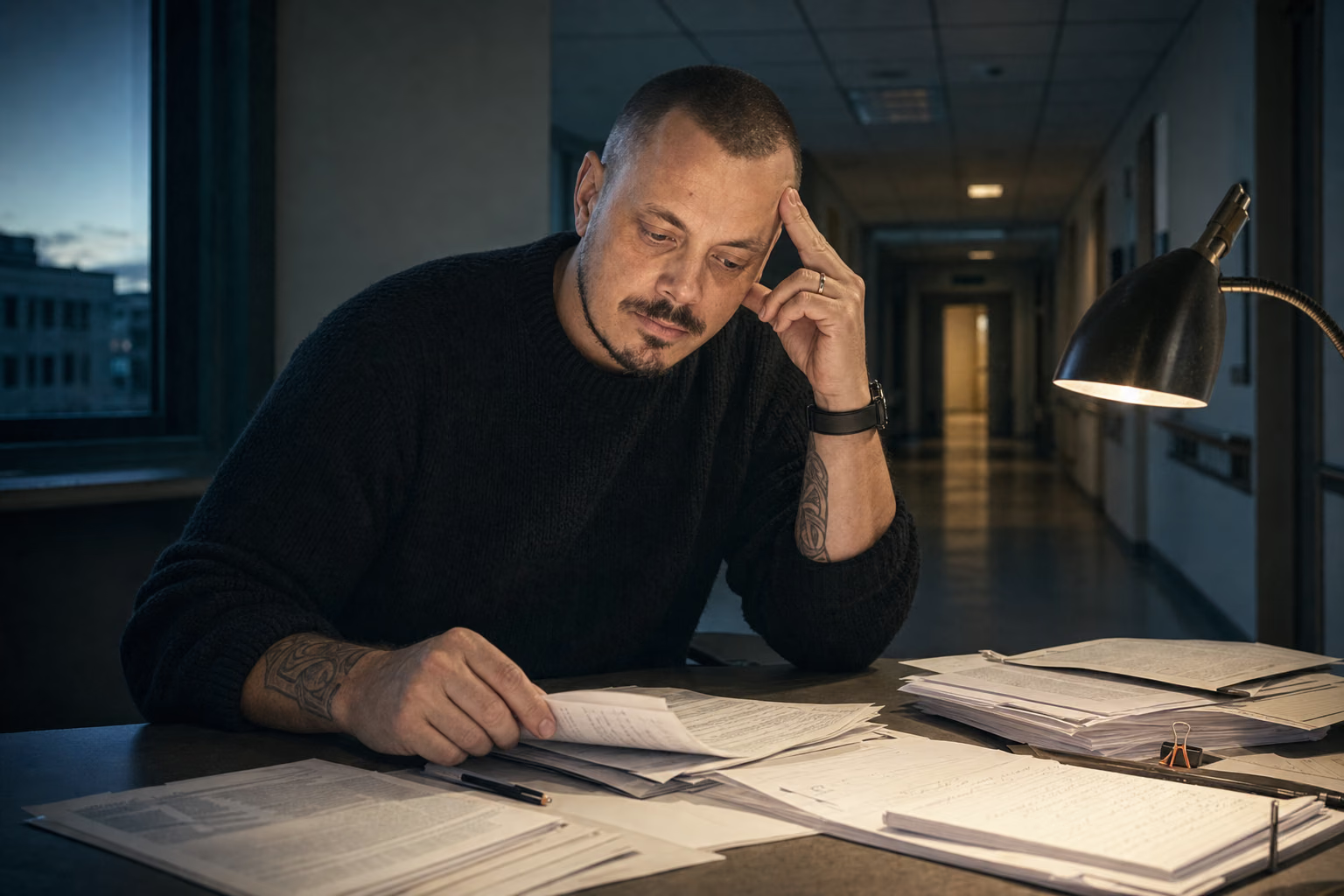
On May 10, 2025, I stood in front of a stage at Smukfest’s volunteer festival watching an AC/DC cover band. My phone vibrated. My daughter wrote: “Grandpa has cancer.”
I didn’t break down. I’m a fixer. Being helpless doesn’t help anyone. So I decided to do the only thing I could: I stepped up.
What I didn’t know was that the doctors had already written off my father. That his medical record would say he had days—maybe a week. That the system had concluded: There is nothing more we can do.
And what I couldn’t possibly imagine was that ChatGPT, Claude, and Gemini would become the difference between life and death.
The glucose meter that “didn’t work”
The weekend after the festival, I was at my parents’ house. My father, Ebbe, was walking around cursing his blood glucose meter. He was newly diagnosed as diabetic—another problem on top of the cough that wouldn’t go away.
I examined the device. There was nothing wrong with it.
The problem was that his blood sugar was so high the meter couldn’t measure it.
“Pack a bag,” I told my mother. “Dad needs to go to the hospital. Now.”
At Skejby Hospital, they took blood tests. CT scans. Biopsies. The picture got worse with each examination.
He had large cell neuroendocrine carcinoma—a rare, aggressive form of cancer. Tumors in the lungs, liver, adrenal glands, bones. Metastases everywhere.
But that wasn’t the worst part.
When the body attacks itself
At the same time as the cancer, my father had developed something called ectopic ACTH syndrome. The tumors were producing a hormone that caused his adrenal glands to secrete enormous amounts of cortisol—the body’s stress hormone.
Normally, cortisol sits below 500 nmol/L. My father’s was over 1,900.
It might sound like just a number. But the consequences were concrete and life-threatening:
His potassium dropped to 2.4 mmol/L—so low his heart could stop at any moment. He developed fluid accumulation in his arms and legs. Gained five kilograms of pure fluid overnight. His blood sugar skyrocketed because cortisol blocks insulin. His immune system collapsed.
The doctor explained it like this: “We can’t give him chemotherapy before we get the cortisol under control. But the cortisol is coming from the tumors. So we’re stuck.”
They tried medication. Pills that were supposed to block cortisol production. Isturisa, it was called. One of the few treatments that exist.
It didn’t work.
The system’s slowness
I have access to my father’s medical records through sundhed.dk. I read them every day. Saw the numbers. Cortisol on May 21: 1,823. May 23: 1,984. May 27: 1,934.
The numbers were going up despite the treatment.
I saw it. But the system moved slowly. MDT conferences. Procedures. Reviews. Assessments.
My father didn’t have time for procedures.
On May 27, a note came from the cancer department. I read it on my phone while driving to Aarhus.
“Thus, the immediate assessment must be that the patient is currently beyond the reach of systemic treatment, and that the focus should be on palliative care.”
Beyond reach.
Further down in the note:
“…both the patient and staff, including the referring doctor, express concern as to whether the patient will even be here when we reach the MDT date, which is in 1 week.”
Palliative. Comfort care. Morphine and peace.
I had to tell my parents. My mother thought the doctors were just “adjusting medication weekly.” She didn’t know.
“Dad,” I said. “I’ve read the note from the cancer department. They don’t expect you to be here in a week.”
Silence.
If we only had one shot
I work with AI every day. It’s my field. And I knew something about these systems: They are exceptionally good at doing thorough research very quickly across sources.
They can’t think. They can’t diagnose. But they can read thousands of scientific articles in seconds and find patterns.
What if…?
The night of May 29, I sat at my computer. I had opened ChatGPT. I had uploaded excerpts from Dad’s journal—data about cortisol, tumor type, previous treatment attempts.
And then I asked the question:
“If we only have one shot in the chamber. If we only have one thing we can do. One kind of Hail Mary. What should we do?”
I specified: Everything must be backed by sources from scientific journals. You must NOT “make things up.” I want a step-by-step treatment plan that healthcare professionals can understand.
Then I pressed enter.
The uncompromising plan
ChatGPT wrote for 20 minutes. The page grew. It became 12 pages.
The title it chose itself: “Uncompromising Treatment Strategy for Ectopic ACTH-Cushing’s in High-Grade NEC”
The plan had two parts:
Step 1: Etomidate infusion
Etomidate is an anesthetic. But it has a side effect: It blocks the enzymes that produce cortisol. It works quickly—within hours.
The problem: You can’t use it for long. It requires intensive care. The patient becomes sedated. It’s “off-label”—not approved for this purpose.
But it could knock the cortisol down NOW. And that was what we needed: Time.
Step 2: Coiling of adrenal arteries
While Etomidate kept the cortisol down, a radiological procedure should be performed: Guide a thin catheter through the blood to the arteries that supply the adrenal glands. Then block them with small metal coils—like a plug.
Less blood to the adrenal glands = less cortisol production.
That would provide a more permanent solution. So Etomidate could be stopped. So chemotherapy could start.
I sent the entire plan to Claude and Gemini—two other AI systems. I asked them to criticize it. Find errors. Check if ChatGPT had made anything up.
They came back: Nothing to criticize. The sources were real. The logic held.
Now I just needed one thing: To get the doctors to say yes.
“Promise me you’ll read it”
On the morning of May 30, I had a meeting with the attending physician. I had printed the plan. 12 pages. Reference list spanning two pages.
I was nervous. What if it was too aggressive? What if I came across as an arrogant son who thought he knew better than doctors? What if they just filed it away?
“I’ve made this,” I said. “With help from AI. It’s a treatment plan.”
The doctor accepted it.
“It’s important to me,” I said, “that you read it. Don’t just file it away vertically. Promise me you’ll read it.”
She looked at me. Nodded. “I promise.”
Two hours later she came back to the room.
“You know what?” she said. “We’re doing it. We’re moving your father to intensive care and following the plan.”
Dramatic effect
On May 30 at 1:13 PM, the Etomidate infusion started.
On May 30 at 9:03 PM, the cortisol had dropped to 873. Cut in half in eight hours.
On May 31 at 8:00 AM: 442. Within normal range.
The journal entry from June 1:
“Wife and several children report that Ebbe is completely different. Much more awake and alert and fresh.”
On June 2, the doctor wrote:
“This has had a dramatic effect both biochemically and clinically, including decreasing edema tendency and improved sense of well-being…”
Dramatic. It was the doctor’s own word.
But we weren’t at the finish line. Etomidat only works while the infusion is running. My father was trapped in intensive care. The drip kept him alive, but also trapped.
We needed step 2.
The fight for freedom
On June 6, the first coiling procedure was attempted. The radiologists managed to block the right adrenal artery. But the left side failed—the anatomy was too difficult.
Not good enough. The cortisol would come back.
On June 11, he received chemotherapy—Carboplatin and Etoposide—while still in intensive care. They broke protocol to attack the tumors now.
On June 12, they tried to stop the Etomidate. See if he could manage without it.
The cortisol shot from 585 to 1,237 in one night. Alarm. Back to intensive care. Etomidate restarted.
He was trapped.
Then on June 18, the radiologists tried again. This time a different technique—venous embolization of the left adrenal glands.
It worked.
The cortisol stabilized. Etomidate could be paused. He was moved out of intensive care.
On June 20, he walked with a walker for the first time. The physiotherapist by his side.
On July 4, he was discharged.
The summer he wasn’t supposed to have
On July 7, the doctor called to see how he was doing.
“Fine,” my father said. “We’re planning a vacation on Samsø.”
On July 23, he came for a checkup after two rounds of chemotherapy. The CT scan showed:
“Decreasing lymph nodes both above and below the diaphragm. Reduction of other lesions.”
The tumors were shrinking.
“How are you doing?” the doctor asked.
“I’m mowing the lawn at the summer house,” my father said.
In August, he walked with a cane. Drove a car. Sat in the garden and enjoyed the sun.
On August 11—three months after the “beyond reach” note—he drove himself to Smukfest to pick me up after the festival. The exact same festival where it all started.
In October, we celebrated his 69th birthday. It was supposed to have been his funeral. Instead, it was a party. Friends. Family. Laughter. Dancing and music. Him in the center.
It was a magical day none of us believed would happen.
What time is worth
My father died at the end of 2025. The cancer won in the end. We knew that.
But he got six months. Six months the system had written off.
What is six months worth?
It’s a summer on Samsø. Mornings in the garden. Audiobooks in his ears while he trimmed the hedge. Driving a car again. Walking with a cane instead of lying in bed.
It’s a birthday surrounded by those you love.
And it was time he wasn’t supposed to have. Not according to the system.
What I learned about the system
I’m not angry at the doctors. I owe them my father’s life. They approved the plan. They executed the treatment. They took the risk.
But I understand now something about the system they work in.
The system is designed to say no when complexity exceeds capacity.
My father’s condition was rare. Two rare diseases at once. Etomidate for Cushing’s syndrome is not standard. Adrenal artery coiling is a niche procedure. The literature is sparse. The evidence is weak.
So the system says: We don’t know enough. We can’t justify it. Focus on palliative care.
It’s not malice. It’s design.
The problem is just that the patient—my father—didn’t fit the system’s categories. He didn’t fit the template.
That’s where AI helped.
Not because AI is smarter than doctors. But because AI has time to read everything.
A doctor has 15 minutes per patient visit. They have 40 other patients. They have administrative tasks. Meetings. Paperwork.
They don’t have 20 hours to go through 200 scientific articles about a rare treatment for a rare disease.
ChatGPT did.
What AI actually did
Let me be honest: Without AI, my father would have died in May.
The doctors had concluded. The system had said no. There was nothing more to do.
AI found a way. Not because it’s smarter than doctors. But because it can do something doctors can’t: Read everything. In one night. Find the needle in the haystack.
A doctor has 15 minutes per patient visit. 40 other patients. Administrative tasks. Meetings.
ChatGPT had 20 hours and no other patients.
That was the difference.
The doctors executed the treatment. They took the risk. They deserve the credit for saying yes.
But the idea? The plan? The 12 pages with step-by-step instructions and sources?
That was AI.
What are we waiting for?
There are ethical dilemmas here. GDPR. Data security. Risk of people using AI wrongly and making dangerous decisions.
All of that is real. All of that should be taken seriously.
But I also think:
How many others are out there right now in the same situation?
How many families get an “beyond reach” because the system doesn’t have the capacity to dive into complexity?
How many rare diseases—where medical textbooks fall short—could have treatment options buried in the literature somewhere?
How many lives could get more time—not a cure, but time—if someone had the tools to find it?
I don’t know what the answer is. But I know that AI made a difference for my father.
And if it can save lives—what are we waiting for?
Ebbe’s voice
My father said it this way:
“If it hadn’t been for my son, I would have kicked the bucket. I have no doubt about that. That would have been the consequence.”
My mother added: “It’s completely wild. Yes, it’s actually a miracle.”
It wasn’t a miracle. It was medicine. Chemistry. Procedure. Skilled treatment by competent doctors.
But it was also something else: It was refusing to accept a no when there might—just might—be a way forward.
Not as arrogance. As love.
I end with the image I have in my head from June 12. My father was lying in intensive care. He was awake and alert for the first time in weeks.
He asked the nurse for something:
“Can you turn my bed? I want to see out the window.”
He wanted to see the sky.
That was all he asked for. And he got it.
In memoriam Ebbe Freltoft Knudsen, 1956–2025
Note to the reader:
This story is true and based on actual medical records from Aarhus University Hospital. All medical decisions were made by qualified doctors. AI tools were used for research and patient advocacy, not for diagnosis or treatment.
If you’re considering similar steps, remember: Always present findings to your doctor. Verify sources. Use multiple AI systems to check each other. And understand that your doctor’s final assessment is decisive.
AI is a tool. Doctors are the experts.
Related Articles
- The Last Insult — AI is humanity’s fourth narcissistic injury
- The Liar in the Engine Room — Why your AI is designed to hide the truth
- Knowledge Explosion — When knowledge begins to produce itself
- When Work Disappears — What is a human supposed to do with themselves?