Knowledge Explosion
When knowledge begins to produce itself. A theoretical analysis of AI-driven knowledge production and what it means for humanity's future.
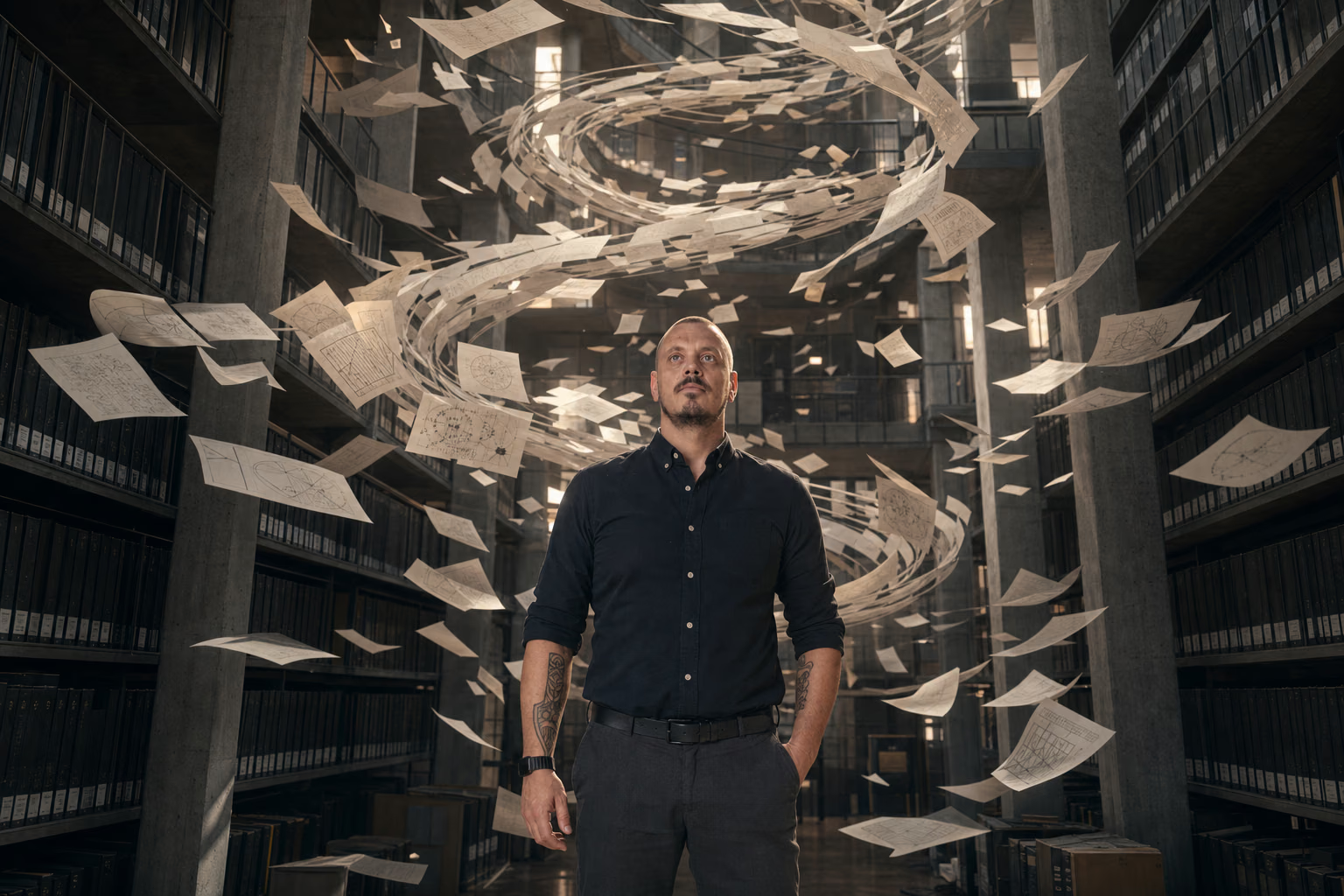
A Researcher and Her Assistant
Maria is a structural biologist. Her work is about understanding the three-dimensional shape of proteins—the microscopic machines that all life is built from. For twenty years, she has used X-rays, cryo-microscopes, and endless patience to reveal how these molecules fold.
In 2021, something happened that changed everything.
An AI system called AlphaFold could suddenly do in seconds what used to take her months. Not by guessing, but by predicting protein structures with nearly the same precision as her laboratory equipment. When she first saw the results, she thought there must be an error. There wasn’t.
Now, four years later, Maria sits in her office pondering what her field has actually become. She still uses the laboratory—there are things AlphaFold can’t see, nuances it misses. But her role has changed. She is no longer primarily the one who finds structures. She is the one who asks questions that the machine doesn’t know it should ask.
Her younger colleagues experience it differently. They have never known a world where protein structure determination was a life’s work. For them, AlphaFold is just another tool—like the PCR machine or the sequencing robot. They wonder why Maria ever did it the slow way.
Maria’s story is not unique. Variations of it are playing out right now in laboratories, offices, and creative studios around the world. Something is changing in the way we produce knowledge. The question is what it means.
What This Analysis Is About
You’re holding a document that attempts to understand this change—not by predicting exactly what will happen, but by giving you a conceptual framework for thinking about the possibilities.
The core observation is simple: Knowledge begets knowledge. The more we know, the more new questions we can ask, and the more new answers we can find. This has always been true. What’s new is that we now have systems that can participate in this process in ways we didn’t have before.
We will use a surprising analogy to explore this: epidemiology, the study of how diseases spread. Not because knowledge is a disease—it certainly is not—but because the mathematical models epidemiologists have developed over a century capture something important about self-reinforcing processes. And knowledge is very much a self-reinforcing process.
The analogy has an uncomfortable point: Epidemics usually stop because people become immune. When enough people have had the disease, it can’t spread further. But knowledge has no herd immunity. We don’t become satiated from knowing things. On the contrary—the more we know, the more we can learn.
This raises a question that this analysis will circle around: If there is no natural brake, what stops the growth?
What This Is Not
Before we continue, we should be honest about what this document is not.
It is not a prophecy. We will not tell you when AI will surpass human intelligence, whether the singularity comes in 2035 or 2050, or whether your profession is safe. We don’t know, and we wouldn’t believe anyone who claimed to know.
It is also not a mathematical proof. We use equations along the way—they help make our assumptions clear—but we don’t solve them precisely, and we don’t calibrate them against data. This is not a flaw in the analysis; it’s an acknowledgment that we don’t have the data that would be required.
What we offer is a conceptual framework. A way to organize thoughts about a complex subject. A frame that can help you ask better questions, even if it doesn’t provide definitive answers.
We believe that has value. But we ask you to read critically. Ask yourself along the way: Does this analogy hold? Is that assumption reasonable? What are the authors overlooking?
Enjoy the read.
Knowledge as Contagion
To understand where we’re heading, we must first take a detour through epidemiology—the branch of medicine that studies how diseases spread in populations.
You might think: What do infectious diseases have to do with artificial intelligence? The answer is: more than you might expect. Not because knowledge is literally a disease, but because the mathematical models epidemiologists have developed over a century capture something deep about self-reinforcing processes. And knowledge spreading is precisely such a process.
The Office Flu
Imagine an open-plan office with a hundred people. One Monday morning, one person shows up sick—let’s call him Erik. Erik has the flu, but he doesn’t know it yet. He just feels a bit tired.
Throughout the day, Erik sneezes a couple of times, touches door handles, eats lunch in the cafeteria. Without knowing it, he infects three of his colleagues. Tuesday, four people are sick. Wednesday, eleven are sick. Thursday, sick calls are flooding in.
But then something interesting happens. The spread slows down. Not because the virus has become weaker, but because more and more of the people Erik and the other sick people encounter have already been sick. They’ve become immune. When half the office has had the flu, it’s hard for the virus to find new victims. The epidemic dies out.
This pattern—rapid growth that gradually slows and eventually stops—has a precise mathematical description. In 1927, the Scottish researchers Kermack and McKendrick formulated the model we still use today.
The SIR Model
The model divides the population into three groups:
S stands for susceptible. These are all those who haven’t yet been sick and therefore can become infected.
I stands for infected. These are those who have the disease right now and can infect others.
R stands for recovered. These are those who have overcome the disease and are now immune.
The beauty of the model is that it explains why epidemics stop. Every day, the infected infect some of the susceptible, who then become infected themselves. But every day, some of the infected also recover and move to the group of immune people. Over time, the pool of susceptible people shrinks because they have either gotten sick or avoided it by luck.
When the pool of susceptible becomes small enough, each sick person on average can no longer infect more than one other person. Then the number of sick people begins to fall. The epidemic burns out.
This is herd immunity. It’s the reason not everyone dies of plague, why flu is seasonal, why measles disappeared when we vaccinated enough children. Epidemics have a natural brake.
Now Think About Ideas
Let’s transfer this to knowledge.
Imagine a researcher gets a new idea—let’s say a new way to treat a certain type of cancer. She publishes a paper. Other researchers read it, become inspired, build on it. Someone combines her idea with something from a completely different field. New papers are written. The idea spreads.
So far, it looks like an epidemic. But here comes the crucial difference.
When you’ve read about the new treatment method, you don’t become immune to more ideas. You actually become the opposite: more susceptible. Now you know something you didn’t know before. Now you can understand papers that built on that knowledge. Now you can combine it with things you already knew and perhaps create something entirely new.
In epidemiological terms: In the knowledge system, people don’t become recovered. They remain susceptible—no, they become more susceptible. The more you know, the more new ideas you can absorb.
It’s as if influenza made you better at catching other diseases.
Recombination: When Knowledge Meets Knowledge
There’s yet another effect that makes knowledge fundamentally different from contagion.
Think of a biochemist who learns programming. Or a linguist who learns statistics. Or an architect who learns about new materials. In each case, something interesting happens: The two knowledge fields collide, and out of the collision can emerge something that neither field could have created alone.
Bioinformatics emerged when biology met computer science. Behavioral economics emerged when economics met psychology. Materials physics was revolutionized when quantum physics met chemistry.
Mathematicians call this combinatorial explosion. If you have ten ideas, you can in principle combine them in 45 different ways (each pair). If you have a hundred ideas, there are 4,950 possible pairs. If you have a thousand ideas, there are nearly half a million pairs.
The more we know, the more combinations are possible. And many breakthroughs come precisely from unexpected combinations—from people who knew something about two fields that normally didn’t talk to each other.
Why This Is Relevant Now
For thousands of years, humanity’s total knowledge grew slowly. A philosopher in ancient Athens could realistically know most of what was worth knowing. A scientist in the 1600s could still follow multiple fields. Today, specialization is unavoidable—there is simply too much to know.
But our brains haven’t changed. We still read at the same speed, remember roughly the same amount, still have only 24 hours in a day.
These human limitations have functioned as an invisible brake on knowledge growth. Not herd immunity—that doesn’t exist for knowledge, as we said—but a practical bottleneck. There were limits to how fast humans could generate, spread, and absorb new ideas.
Now we have systems that don’t have the same limitations.
They read faster than us. They remember more than us. They can combine knowledge from fields that no human has ever mastered simultaneously. They don’t sleep.
The question is no longer whether knowledge can spread quickly. It always could, in principle. The question is what happens when the practical brakes—the human limitations—begin to loosen.
That is the subject for the rest of this analysis.
Two Kinds of Knowledge
Before we continue, we must stop and distinguish between two things that are often confused. This is perhaps the most important distinction in this entire analysis.
Rumors and News
You know the difference from everyday life.
Someone says: “I heard the shop on the corner is closing.” That’s a rumor. Maybe it’s true, maybe not. You have no idea where the information comes from or how reliable it is.
But if you read in the local newspaper that the shop has filed for bankruptcy, it’s different. A journalist has verified it. There’s a source—a public registration, a statement from the owner. The information has been validated.
Both are information. Only one is confirmed knowledge.
Hypotheses and Validated Knowledge
In science, we have exactly the same distinction, just with more formal rules.
A hypothesis is an idea that could be true. It’s a proposal, a draft, a conjecture. “Maybe this compound works against cancer.” “Maybe the protein folds this way.” “Maybe there’s a connection between these two phenomena.”
Hypotheses are cheap to produce. A clever person with a good afternoon can generate ten hypotheses. That’s why Einstein said imagination is more important than knowledge—because imagination creates the hypotheses that knowledge must then test.
But hypotheses are not knowledge. They are candidates for knowledge.
Validated knowledge is something else. It’s hypotheses that have survived testing. The compound actually worked against cancer—in cell cultures, in mice, in clinical trials with thousands of patients. The protein actually folds that way—confirmed with X-ray crystallography, with cryo-microscopy, by independent laboratories. The connection actually holds—replicated by other researchers, with other data, in other countries.
Validation is expensive, slow, and difficult. That’s why science takes time.
H and K
Let’s give the two things names so we can talk precisely about them.
We call the pool of unvalidated hypotheses H. These are all the ideas floating around in the system—papers not yet peer-reviewed, theories not yet tested, conjectures not yet confirmed. H grows every time someone gets an idea.
We call the pool of validated knowledge K. This is what we actually know—the results that have been tested and held up, the theories that have survived falsification attempts, the medicines that actually work. K grows only when a hypothesis survives validation.
The relationship between H and K is central to understanding what’s happening with the knowledge system.
The Validation Bottleneck
Historically, validation has been a bottleneck. It simply takes a long time to test things properly.
Take Fermat’s Last Theorem. In 1637, the mathematician Pierre de Fermat wrote a note in the margin of a book: He had found a “marvelous proof” that the equation x^n + y^n = z^n has no integer solutions for n > 2. He died without writing down the proof.
For 358 years, it was a hypothesis. Mathematicians around the world tried to prove it. Only in 1995 did Andrew Wiles succeed—after seven years of intensive work.
That’s an extreme example, but the pattern is general. Validation takes time.
A new drug typically takes 10-15 years from first idea to approval. First it must be tested in cell cultures. Then in animals. Then in small groups of people. Then in large groups. Each step takes years and costs millions.
This slowness has functioned as a natural regulation of the relationship between H and K. Hypotheses could be generated quickly, but they piled up in front of validation’s bottleneck. The system couldn’t run away because validation held it back.
AlphaFold and the Future of Validation
Now something interesting is happening.
We mentioned AlphaFold in the introduction. Let’s look more closely at what it actually means.
Before AlphaFold, protein structure determination was a form of validation. You had a hypothesis about how a protein folded. To validate it, you had to crystallize the protein, bombard it with X-rays, analyze the diffraction pattern. It took months or years, required specialized equipment and expertise, and didn’t always work.
AlphaFold changed the equation. Suddenly you could get a structure prediction in seconds—with an accuracy that in many cases matched experimental methods. It’s not perfect. There are still things that require laboratory work. But for a large part of the protein universe, AI has made validation faster.
The same pattern is repeating elsewhere. Weather models that used to require days of supercomputer time can now run in hours. Material simulations that used to be impractical are now routine. Mathematical conjectures that used to require human ingenuity are now solved by symbolic systems.
The bottleneck is widening.
What Happens Then?
Here is the central question: If validation becomes faster, what happens to the relationship between H and K?
In the old regime, H was large and growing while K grew slowly. There was a growing “debt” of unvalidated hypotheses.
In the new regime—if it comes—K can begin to grow faster. Hypotheses can be validated almost as quickly as they’re generated.
But wait. Remember what we said about knowledge: It creates more knowledge. If K grows faster, more new hypotheses are also generated. And if they can be validated faster…
You can see where this is going. We’re beginning to glimpse the outline of a self-reinforcing process.
But before we explore that, we need to talk about another ingredient: computing power.
The Role of Computing Power
Everything we’ve talked about so far—AI systems that predict protein structures, models that simulate weather, machines that generate and validate hypotheses—has one thing in common. They require computing power. Enormous amounts of computing power.
So before we can understand where the knowledge system is heading, we must understand what’s happening with computers.
What Is Computing Power?
Let’s start from the basics. A computer is in its essence a machine that can perform simple arithmetic operations—addition, subtraction, comparison of numbers—incredibly fast. When we talk about “computing power” or “compute,” we mean how many of these operations a machine can perform per second.
Your phone can perform billions of operations per second. A modern data center can perform trillions. The largest supercomputers in the world reach quintillions—that’s a number with eighteen zeros.
These numbers are so large they’re hard to relate to. But here’s what’s important: They’re growing. And they’ve been growing for decades.
Moore’s Law and Its Friends
In 1965, Gordon Moore, one of Intel’s founders, noticed an interesting pattern. The number of transistors—the microscopic switches that make up a computer chip—was doubling roughly every two years. And because more transistors means more computing power, this meant computers were becoming twice as powerful at the same interval.
This pattern held for over fifty years. Your smartphone today is millions of times more powerful than the computers that sent humans to the moon.
But Moore’s Law is about transistors, and transistors have a physical size. We’re now down to sizes where quantum mechanical effects begin to interfere. A transistor is only a few atoms wide. There’s a limit to how small they can become.
This has led many to ask: Are we hitting the wall? Is the growth in computing power stopping?
The answer is: Maybe for classical silicon chips. But there are other paths.
Four New Paradigms
Imagine you’re running out of gas on the highway. You can try to squeeze the last drops out of the tank. Or you can switch to a different kind of fuel.
Something similar is happening in the computer industry right now. While classical chips reach their limits, several alternative technologies are maturing.
Quantum computers exploit the strange properties of quantum mechanics to solve certain problems exponentially faster than classical computers. Google’s Willow chip and IBM’s roadmap toward 100,000 qubits by 2033 are milestones. We’re far from quantum computers replacing your laptop—but for specific tasks, they’re beginning to become useful.
Neuromorphic chips mimic the brain’s architecture. Instead of separating memory and computation, as traditional computers do, they integrate them—like your neurons. The result is systems that use a fraction of the energy for certain tasks, especially pattern recognition.
Photonic computers use light instead of electrons. Light travels faster and generates less heat. We’re still in the early stages, but the potential is enormous.
Thermodynamic computers are perhaps the most exotic alternative. Instead of fighting thermal noise—the random movement of atoms that is normally the enemy—they exploit it. It sounds like science fiction, but there are startups working on it.
The point is not to predict which of these technologies will succeed. The point is that there are multiple paths forward. If just one of them delivers significant improvements, growth in computing power continues. If several succeed, it accelerates.
The Double Helix
Now we come to something important. For computing power and knowledge are not independent quantities. They affect each other.
Think about it from one side: More computing power gives more knowledge. AlphaFold required enormous amounts of compute to train. Each new generation of AI models is larger and requires more resources. When we have more computing power, we can run more experiments, train larger models, simulate more complex systems. Compute produces knowledge.
But it works the other way too: More knowledge gives more computing power. Better understanding of materials gives better chips. Better algorithms make our computations more efficient. Better AI systems help design the next generation of hardware.
AlphaChip is a concrete example. Google’s AI system now designs chip layouts faster and often better than human engineers. AI is helping build the hardware that AI runs on.
When two things reinforce each other this way, we call it a feedback loop. It’s like compound interest: The more you have, the faster it grows, and the more you get, so it grows even faster.
Compound Interest for Knowledge
Let’s dwell on that analogy for a moment, because feedback loops are central to understanding what may be happening.
Imagine you put 1,000 dollars in the bank at 5% interest. After one year, you have 1,050 dollars. The next year you get 5% of 1,050—that’s 52.50 dollars. The year after you get 5% of 1,102.50 dollars. And so on.
At first, the difference is almost imperceptible. But over time, growth accelerates. After 50 years, you don’t have 3,500 dollars (1,000 plus 50 times 50 dollars), but over 11,000 dollars. After 100 years, you have over 130,000 dollars.
This is exponential growth: The growth rate is proportional to how much you already have.
Now imagine an even stronger effect: What if the interest rate itself increased the more money you had? What if having 10,000 dollars didn’t just give you 5% interest, but 6%? And 100,000 dollars gave 7%?
That would be faster than exponential growth. Mathematicians call it super-exponential or even hyperbolic growth.
Our claim—and it is a claim, not a proof—is that the knowledge system may have this structure. More knowledge gives more computing power, which gives more knowledge, which gives better methods for creating knowledge, which accelerates it all.
Whether it actually happens, we don’t know. But the structure is there.
Constraints That Move
Now we need to talk about something that may seem counterintuitive. It’s also the most controversial argument in this analysis, so we ask you to read it with a critical eye.
When experts discuss the future of AI and knowledge creation, they often point to constraints. Some say: “Validation requires physical experiments, and you can’t speed those up.” Others say: “Infrastructure takes decades to build.” Others again: “Energy consumption is unsustainable.”
We don’t dispute that these constraints exist. They do. The question is whether they are permanent.
Two Kinds of Constraints
Think about the difference between these two statements:
“You cannot travel faster than light.”
“You cannot fly from Copenhagen to New York in under an hour.”
The first is a fundamental physical law. As far as we know, it applies everywhere in the universe, at all times. No amount of technological development will change it.
The second was true in 1950, but is not necessarily permanent. Concorde did it in three hours. Future hypersonic aircraft may be able to do it faster. The constraint was not physics—it was technology.
We use two words to distinguish between these types:
Exogenous constraints are those that don’t depend on how much we know. The speed of light is exogenous. The laws of thermodynamics are exogenous. The rules of mathematics are exogenous. They are outer limits that reality sets.
Endogenous constraints are those that themselves depend on knowledge. “We can’t do X” often means “we don’t yet know how to do X.” These limits can shift as we learn more.
Here is the central point: Many of the constraints experts point to are not exogenous. They are endogenous. They look like solid walls, but they are more like fog banks that can lift.
Three Stories About “Impossibilities”
Let’s look at some examples from history.
Flight (1895)
At the end of the 1800s, most experts agreed that heavier-than-air flying machines were impossible. Lord Kelvin—one of the era’s most respected physicists—said it directly. The arguments seemed convincing: Birds are light for their size, have perfected wings, and still struggle to fly. How would a heavy machine with a human on board ever take off?
Eight years later, the Wright brothers flew.
The constraint was not physics. It was our understanding of aerodynamics. When we knew more, we could do more.
Computers (1943)
Thomas Watson, CEO of IBM, allegedly said in 1943: “I think there is a world market for maybe five computers.”
It sounds ridiculous today. But think about what a computer looked like in 1943: It filled an entire room, cost a fortune, required specialists to operate, and constantly broke down. To imagine one in every home—or in every pocket—was absurd.
The constraint was not demand or physics. It was our ability to build small, cheap, reliable computers. When we knew more, we could do more.
The Internet (1995)
Robert Metcalfe, the inventor of Ethernet, predicted in 1995 that the internet would collapse catastrophically the following year. He was not a random skeptic—he was one of the people who understood the technology best.
His arguments were technical and seemingly solid: The infrastructure couldn’t handle the growth, the protocols weren’t robust enough, the system was too fragile.
He was wrong. Not because his analysis was stupid, but because he underestimated how quickly we would solve the problems. The constraint was not infrastructure. It was our knowledge of how to build scalable infrastructure.
The Pattern
These stories are not random. There is a pattern.
Again and again, experts have pointed to constraints that seemed absolute but turned out to be relative. “Impossible” meant “we don’t know how.” And when we learned how, the boundary shifted.
This doesn’t mean all constraints are endogenous. Some are truly fundamental. But it does mean we should be careful about assuming that today’s constraints are permanent.
What Is Truly Exogenous
To prevent this argument from becoming a blank check to dismiss all criticism, let’s be precise about what we consider genuinely exogenous constraints:
The second law of thermodynamics: Entropy—disorder—always grows in closed systems. You can’t build a perpetual motion machine. No amount of knowledge changes this.
The speed of light: Information cannot travel faster than light. This sets fundamental limits on communication and coordination.
The Landauer limit: There is a minimum amount of energy required to erase a bit of information. Computers cannot become infinitely efficient.
Quantum mechanical uncertainty: There is a limit to how precisely we can measure certain things simultaneously. Heisenberg’s uncertainty principle is not a technical problem we can solve.
Logical consistency: Mathematics cannot contradict itself. A proof is a proof.
If someone criticizes our analysis by invoking these limits, we should listen. They are real limits.
But if the criticism is “infrastructure takes decades to build” or “validation requires physical experiments” or “we don’t have enough energy,” then we should ask: Is this truly exogenous? Or is it something new knowledge could change?
The Uncomfortable Implication
Here is why this matters.
Much of the serious criticism of accelerating AI development takes the form: “It can’t happen that fast because X slows it down.”
If X is truly exogenous, the criticism is valid. If X is endogenous, the criticism is potentially circular. It assumes that today’s constraints will hold—but if knowledge grows quickly, perhaps the constraints also change.
We’re not saying the critics are wrong. We’re saying their arguments often rest on a hidden assumption they haven’t justified: that today’s world is permanent.
That is just as much an assumption as our analysis. None of us knows what the future holds.
Five Futures
We now have all the pieces in place: Knowledge that reinforces itself. Validation that becomes faster. Computing power that grows. Constraints that may be endogenous.
How do we put it together? What could happen?
In this chapter, we will describe five qualitatively different scenarios—five possible futures. Not because we believe one of them is the right one, but because they help think about the spectrum of possibilities.
Think of them as maps of terrain we haven’t visited yet.
Future 1: Saturation
Imagine we’re writing in 2040. The world looks roughly like 2025, just a bit better.
AI is ubiquitous and useful. It writes your emails, plans your meetings, helps doctors diagnose. But it hasn’t fundamentally changed how science works. Labs still look roughly like before. Papers are still written by humans. Progress still comes slowly.
What happened? The constraints experts pointed to held up. Energy consumption set a ceiling. Algorithm progress plateaued. Quantum computers remained a niche. AI became a powerful tool, but not a co-researcher.
In this scenario, the skeptics were right. The end of Moore’s Law marked a new era of slower progress. The S-curve flattened, as it has for so many previous technologies.
There’s a historical parallel: nuclear power. In the 1950s, many believed nuclear power would revolutionize everything—cheap, clean, unlimited energy. It didn’t happen. Not because the physics was wrong, but because the practical, economic, and political constraints turned out to be harder than expected.
Maybe AI is in the same situation. Maybe we’re in the middle of the hype cycle’s peak, and the downturn awaits.
How would you experience this scenario? Changes would feel gradual. Your career would still make sense in ten years. Your children would learn skills that were still relevant when they grew up. The future would feel like an extension of the present.
Future 2: Controlled Acceleration
Now imagine a different world in 2040. Things have changed noticeably, but society has kept pace.
AI has transformed many industries. Half of the jobs that existed in 2025 no longer exist—but new ones have emerged in their place. The education system has adapted. Legislation has kept up. There are problems and conflicts, but the institutions function.
Science has accelerated. New drugs are developed in years instead of decades. Climate technology has made progress that seemed unlikely in 2025. We know things we didn’t know we didn’t know.
But humans are still in the driver’s seat. AI is a tool—an extremely powerful tool—but decisions are still made by humans. There are checks and balances. The system is under control.
The historical parallel here is the internet from 1995 to 2020. A profound transformation that changed almost everything—how we work, communicate, trade, entertain ourselves. But a transformation that happened fast enough to be noticeable, slow enough to be manageable.
How would you experience this? Your career would probably change dramatically at least once. You would have to learn new things your whole life. Some things would feel foreign, but you would be able to adapt. Your children would have opportunities you didn’t have—and challenges you can’t imagine.
Future 3: Rapid Transformation
In this scenario, change outpaces our ability to keep up.
Imagine 2040, but a 2040 that looks less like 2025 than 2025 looks like 1990. Technologies that were science fiction five years ago are now common. Scientific fields emerge and become obsolete in months, not decades. Expertise has a half-life.
Institutions struggle. Legislation constantly lags behind. Education feels like aiming at a moving target while blindfolded. International agreements are outdated before the ink is dry.
It’s not chaos—things function—but it’s disorienting. That feeling of the world moving faster than you can keep up with, which some already have today, has become the permanent state.
The historical parallel is the Industrial Revolution, but compressed. What took a century then might take a decade or two now. And back then there were social upheavals, wars, revolutions. The transition was not smooth.
How would you experience this? Constant adaptation. Strategies that worked last year don’t work this year. Careers that looked secure disappear. New opportunities arise faster than you can evaluate them. The future doesn’t feel like an extension of the present—it feels like a foreign country.
Future 4: Singularity
Now we move into territory that is harder to describe. Not because it’s unrealistic, but because it is by definition unpredictable.
Imagine a point where AI systems become capable of improving themselves faster than humans can follow. Each new generation of the system is smarter than the previous one. And because it’s smarter, it can design the next generation even faster.
In mathematics, we call this hyperbolic growth: A curve that doesn’t just rise, but rises with accelerating speed, until in principle it goes toward infinity at a specific point in time.
In practice, nothing goes to infinity. There will be constraints—the laws of physics, resources, something. But the point is that we can’t necessarily predict what those constraints are, or when they kick in.
The singularity—as science fiction author Vernor Vinge called it—is not a specific scenario. It’s the name for our ignorance. It’s the recognition that if things accelerate fast enough, we can no longer predict what comes next.
Here it’s important to say what the singularity is not.
It is not necessarily doomsday. Hollywood has taught us to fear superintelligent machines that exterminate humanity. That is one possibility, but far from the only one.
It is also not necessarily utopia. Techno-optimists imagine a future where AI solves all problems and we live in abundance. That is also one possibility, but not guaranteed.
What the singularity is is an epistemological concept. It is the point where our ability to predict breaks down—not because we lack data, but because the system evolves faster than we can model it.
We don’t know if this scenario is possible. We don’t know if the feedback loops we’ve described are strong enough to trigger it. We don’t know if there are exogenous constraints we haven’t thought of.
But we can’t rule it out.
Future 5: Erosion
There is one more scenario we must talk about. One that is not about acceleration, but about quality.
Imagine a world where AI produces enormous amounts of text, images, code, data. More than any human can oversee. More than any system can validate.
At first, it seems fantastic. So much information! So many ideas! But gradually you start to notice something. The quality fluctuates. Things that sound convincing turn out to be wrong. Sources you thought were reliable have been contaminated.
It’s not a sudden catastrophe. It’s a slow erosion. The difference between hypothesis and knowledge—between H and K—becomes harder to distinguish. Unvalidated information is used as input to decisions and to train new systems. Noise accumulates.
This is not an inevitable scenario. It’s a scenario that requires several things to go wrong simultaneously.
It requires AI generation to scale faster than AI validation. But AI can also validate—fact-check, consistency-check, spot errors. If validation keeps pace with generation, H and K grow together, and the ratio remains stable.
It also requires that we use unvalidated information as if it were validated. But we can choose not to. We can insist on provenance—on knowing where information comes from. We can distinguish between “AI generated this” and “this has been tested.”
And it requires that distributed validation fails. Today, something like Wikipedia works despite millions of edits because errors are discovered and corrected by users. The same mechanism can work for AI-generated information: If it’s used and turns out to be wrong, it’s discovered.
So the erosion scenario is not structurally inevitable. It’s a risk scenario that depends on what choices we make. Some domains are more vulnerable than others: General public debate is more exposed than medicine, where errors have visible consequences.
The point is: This is not something that happens to us. It’s something we can choose to prevent—or fail to prevent.
Where Are We?
We have now described five futures: Saturation, controlled acceleration, rapid transformation, singularity, erosion.
Which one are we heading toward?
The honest answer is: We don’t know.
There are indications pointing in several directions. AI’s capability is rising rapidly—that argues for acceleration. But practical implementation is slower than laboratory results—that argues for saturation. Several compute paradigms are maturing simultaneously—that argues for continued growth. The hype level is extremely high—that argues that we might be overestimating.
Anyone who tells you with certainty which future we’ll get is lying—or lying to themselves.
What we can do is understand the structures that drive toward each future. We can identify early signs. We can prepare for multiple scenarios instead of betting everything on one.
That’s not a satisfying conclusion. But it’s an honest one.
Our Own Blind Spots
We’ve talked a lot about knowledge systems, feedback loops, and future scenarios. Now we must talk about ourselves—the authors of this analysis, but also you as a reader.
For there is a problem we cannot escape: We are all trapped in our own time.
The Fish’s Water
There’s an old joke about two young fish swimming past an older fish. The older fish nods and says: “Morning, boys. How’s the water?” The two young fish swim on, and finally one looks at the other and asks: “What the hell is water?”
We live in a world that shapes our intuitions without us noticing.
Our sense of what is “normal” is based on the decades we’ve lived. Our sense of what is “possible” is shaped by what we’ve seen and heard. Our sense of what is “fast” or “slow” is calibrated to the world we know.
If the world changes fast enough, our intuitions will be misleading.
The Experts’ Track Record
Look at history. Again and again, the smartest people in the world have been wrong about the future—not because they were stupid, but because they extrapolated from their own time.
In 1900, there were experts who said everything that could be invented had been invented. In 1930, there were economists who predicted we would work 15-hour weeks in the year 2000. In 1970, there were demographers who predicted global famine by 1990. In 1995, there were technologists who predicted the internet’s collapse.
The pattern is not that experts are always wrong. The pattern is that experts systematically underestimate how quickly things can change—because they extrapolate from constraints that turn out to be temporary.
But there is also the opposite pattern.
The Symmetric Error
For we must be fair. There are also examples of the opposite: Overestimation of change.
“Fusion in ten years” has been a joke for fifty years. Flying cars should have been here long ago. The paperless office led to more paper for decades. Virtual reality was supposed to have replaced reality in the 1990s. Self-driving cars were supposed to be ubiquitous in 2020.
Enthusiasts systematically underestimate how hard it is to translate technological possibility into practical reality. They forget infrastructure, regulation, user adoption, cultural barriers.
Both errors are real. Experts often underestimate change. Enthusiasts often overestimate it. The question is not who is generally right, but who is right now, about this specific subject.
And that we don’t know.
A Test for Criticism
When someone criticizes this analysis—and criticism is welcome—we suggest a simple test.
Ask yourself: Does the criticism rest on an assumption that today’s constraints are permanent?
If the criticism is “AI can never surpass humans in X because X requires Y”—then ask: Is Y really impossible? Or is it just something we don’t yet know how to do?
If the criticism is “this will take decades because infrastructure is slow”—then ask: Is infrastructure always slow? Or is it slow because we haven’t known how to make it fast?
This is not a way to dismiss criticism. Some criticism is valid. The laws of physics are real constraints. Logic is a real constraint.
But much criticism implicitly assumes that the world in 2025—or 2030 or 2040—will look like the world today. That is not certain.
Our Own Blind Spots
We must be honest about our own limitations.
This analysis is written by beings trapped in 2025. Our intuitions are shaped by a world where infrastructure takes decades, where validation is slow, where computers are big and hot.
If our model is correct—if the world really is heading toward rapid acceleration—then our own assumptions will be misleading. There will be things we can’t imagine. Possibilities we dismiss because they seem unrealistic. Constraints we take for granted because we’ve never seen them broken.
Conversely: If the skeptics are right—if the world is heading toward saturation—then we may be overestimating the pace of change. We see patterns that aren’t there. We extrapolate from short-term trends to long-term conclusions.
We don’t know which error we’re making.
The Position of Humility
Given all this, what is the honest position?
It is not to say “we know what will happen.” We don’t.
It is also not to say “the experts know best.” They’ve been wrong before.
It is also not to say “anything is possible.” There are real constraints.
The honest position is uncertainty. Not the lazy uncertainty that says “who knows?” and shrugs. But the active uncertainty that maps the possibilities, identifies the critical assumptions, looks for early signs.
We have presented an analysis. We have identified structures that could drive acceleration. We have pointed to constraints that may be endogenous. We have described scenarios that possibly await.
We have not proven anything. We have given you a conceptual framework.
The rest is up to reality—and to the choices we make.
What Now?
We have reached the end of the analysis. What should you do with it?
What the Model Doesn’t Give You
Let’s start with what this analysis doesn’t give you.
It doesn’t give you a prediction. We don’t know if we’re heading toward saturation, acceleration, singularity, or erosion. Nobody knows.
It doesn’t give you an action plan. We’re not telling you whether you should change careers, invest in tech stocks, or build a bunker. We don’t know that either.
It doesn’t give you a guarantee. Our analysis may be wrong. The analogy may be misleading. The assumptions may be flawed. We’ve done our best, but we are not prophets.
What the Model Gives You
What it does give you is a conceptual framework—a way of thinking.
When you read news about AI advances, you can now ask: Is this something that primarily increases H (hypotheses) or K (validated knowledge)?
When someone says “that will never happen because X,” you can ask: Is X truly exogenous, or is it something new knowledge can change?
When someone says “it will happen within five years,” you can ask: What are they assuming about feedback loops? About constraints? About validation?
You now have a language for talking about these things. That is valuable, even if it doesn’t provide answers.
Living with Uncertainty
How do you act under deep uncertainty?
One approach is to pick a scenario and bet on it. “I believe we’re heading toward saturation, so I’ll plan as if the world in 2040 looks like the world today.” Or: “I believe the singularity is coming, so I’ll plan as if everything changes.”
That’s an understandable approach, but risky. If you’re wrong, you’re poorly positioned.
A better approach is robustness. Instead of optimizing for one scenario, you can strive to do reasonably well in several.
That means: Build skills that are valuable in many futures. Keep an eye out for early signs. Be willing to change course. Don’t make irreversible choices unless you have to.
That’s not an answer to “what will happen?” It’s a strategy for “what do I do when I don’t know what will happen?”
A Closing Thought
We started with Maria, the structural biologist who saw her field change. Her story is not over. None of our stories are.
What we know is that knowledge begets knowledge. That constraints aren’t always what they appear to be. That systems with feedback loops can behave surprisingly.
What we don’t know is what that means for the next ten, twenty, fifty years.
This analysis is not the final word. It is an attempt to think clearly about something that is very hard to think clearly about.
We hope it has been useful.
Appendix: For the Curious
For readers who would like to see the mathematical structure behind the analysis, we present the equations here. Note that this is conceptual notation—the parameters are not calibrated, and we have not solved the system precisely.
The Three Variables
We work with three main quantities:
H(t) is the amount of unvalidated hypotheses at time t.
K(t) is the amount of validated knowledge at time t.
C(t) is the compute capacity at time t.
How Hypotheses Arise
Hypotheses are generated from existing knowledge:
dH/dt = aK + bK^2 - uH
Here aK represents the incremental ideas—more things we know gives more new questions. bK^2 is the recombination—ideas that arise from combining knowledge from different fields. uH represents hypotheses that become obsolete or are abandoned.
The quadratic term is important. It captures the combinatorial explosion we talked about: The more we know, the more combinations are possible.
How Knowledge Is Validated
Validated knowledge grows when hypotheses survive testing:
dK/dt = v(K) * p(K,H) * V(H,C) - dK
Here v is the validation speed—how quickly hypotheses can be tested. p is the quality of hypotheses—what proportion survives testing. V is the validation capacity—how many hypotheses can be tested simultaneously. dK represents knowledge that becomes obsolete.
The central point is that v can depend on K. Better simulation tools (a form of knowledge) make validation faster. This is the endogenous constraint we talked about.
How Compute Grows
Compute develops through several channels:
dC/dt = Sum_i r_i * C_i * (1 - C_i/C_i,max) + nC + gK_comp
The first term describes growth within each compute paradigm (classical silicon, quantum, neuromorphic, etc.)—logistic growth that saturates at a ceiling.
The second term (nC) describes compute that improves itself—algorithms that optimize hardware utilization.
The third term (gK_comp) describes how knowledge about computing (a part of K) improves compute. AlphaChip is an example of this.
The Feedback Structure
The central point is that K and C affect each other:
- More C gives faster validation, so K grows faster
- More K (especially K_comp and K_materials) gives more C
- More K gives more hypotheses H, which with more C can be validated faster
This is the feedback loop. And if the loop is strong enough, the system can behave differently than simple linear projections would predict.
What We Haven’t Done
To be honest about the limitations:
We haven’t calibrated the parameters (a, b, v, etc.) against data. That would require empirical work we haven’t performed.
We haven’t solved the equations analytically or numerically. That would tell us more about the system’s behavior.
We haven’t modeled time delays—the time it takes from when knowledge is created until it affects the system.
We haven’t modeled social dynamics—regulation, economics, geopolitics.
These limitations mean the model is a thought experiment, not a predictive tool.
But we believe it captures something true about the structure. Feedback loops exist. Constraints can be endogenous. The system can behave surprisingly.
The rest is up to reality to decide.
This document is theoretical analysis developed in dialogue between human and AI.
It is not a prophecy. It is not a proof.
It is a way of thinking.
December 2025
Related Articles
- The Last Insult — AI is humanity’s fourth narcissistic injury
- The Liar in the Engine Room — Why your AI is designed to hide the truth
- The Summer AI Gave My Father — How AI became the difference between life and death
- When Work Disappears — What is a human supposed to do with themselves?