When the Dead Speak
AI may give more dead people an afterlife. But what happens if a historical reconstruction begins to live on?
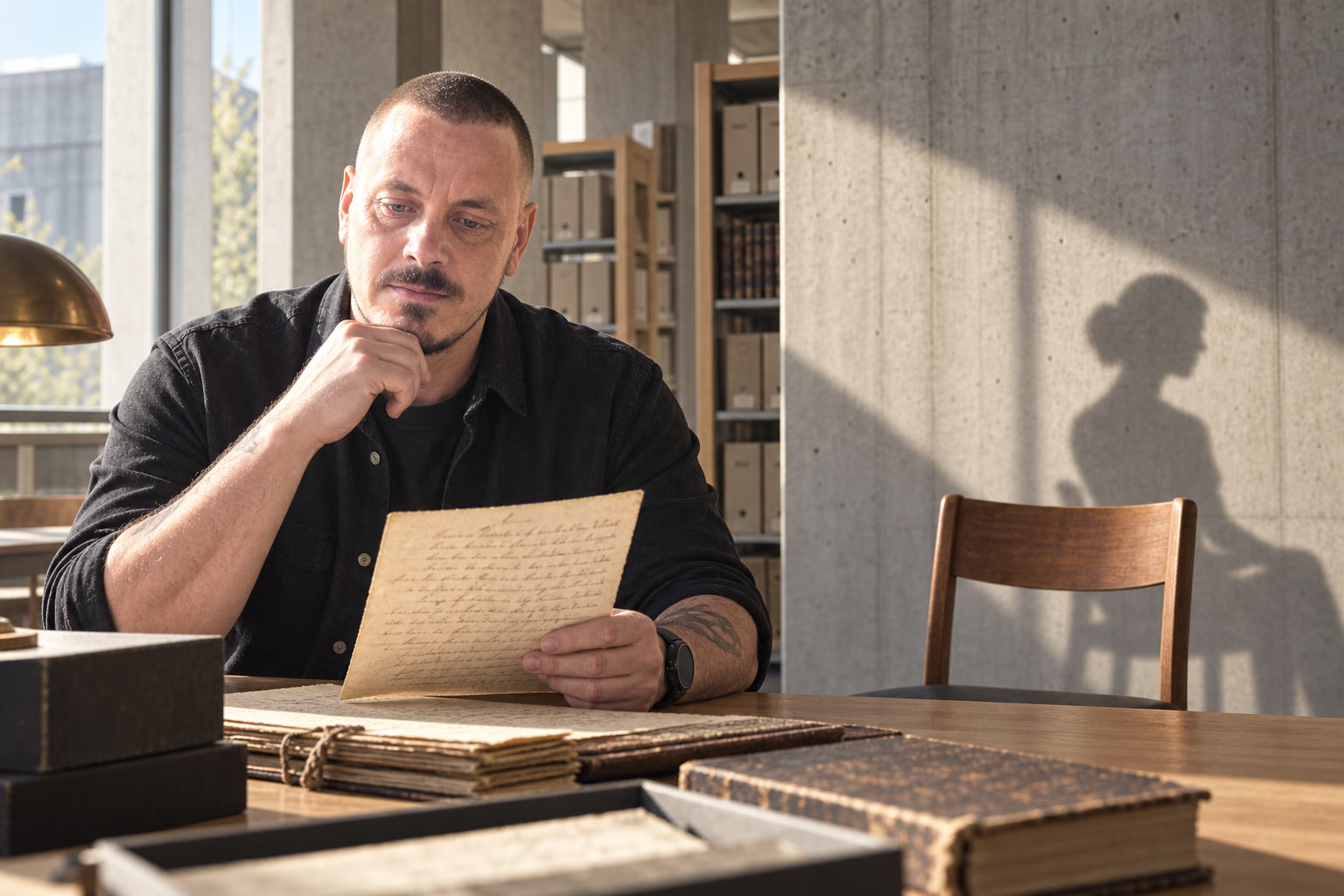
At one point, I found myself sitting with a collection of handwritten letters from the nineteenth century. They had been written by the Danish painter Bertha Wegmann and one of her friends. Over many years, my mother had collected them along with information about the two women, the people around them and the time in which they lived.
Bertha had not been entirely forgotten by history. She was born in Switzerland in 1847, grew up in Denmark, achieved international success as a portrait painter and became the first woman elected to the Royal Danish Academy of Fine Arts’ plenary assembly. Even so, she later slipped out of the conventional story of Danish art until interest in her work began to return.
The letters made it possible to come closer to her than a name, a date and a few paintings in a museum. Here were her own phrases, thoughts and reflections. Here, too, were her friend’s replies—and with them, the remains of a relationship that had unfolded between two living people.
I used the material for an experiment with AI. The model was given the letters and the knowledge about the period my mother had collected, and it was asked to write a kind of autobiography in Bertha’s voice. It could read what Bertha herself had written, hold it against her friend’s replies and connect it with articles and other knowledge about the life around them. In that way, it could try to construct both an account of her inner life and the world through which she moved.
I cannot know whether the result sounded like Bertha. None of us can. She died in 1926, and we cannot place a paragraph in front of her and ask whether she would have written it that way. Whenever something was missing from the material, the model had to fill the gap with what was likely. And the likely is not the same as the true.
But the experiment revealed something else. A large pile of letters could be treated as more than sources for a text about Bertha. They could become the basis for a text that spoke from her possible perspective. It was still a construction, but one capable of gathering her own words, her friend’s reactions and the setting of their time into the same story.
It made me wonder how many other lives are already preserved in this way.
Whom have we had time for?
When we open a history book, we meet a tiny fraction of the people who actually lived. There are kings, generals, writers, artists and politicians. That makes sense. Their decisions and works mattered to many people, and large amounts of material have often survived them.
But history has not only been shaped by who left material behind. It has also been shaped by whose material someone had time to read.
It can take years to assemble a single human life. Letters must be deciphered and placed in the correct order. Names must be identified. A passing remark about a dinner or a journey only makes sense once you know who was there, what the city looked like and what possibilities were open to a person with that particular income, gender and position at that time. My mother’s collection of the Bertha material is itself an example of that work. The papers did not become a coherent story merely because they existed. A person spent part of her life finding them and understanding what belonged together.
That kind of attention is expensive. The historian, the museum and the publisher must therefore choose. And the choice will often fall on someone already famous enough for the work to seem important. We know a great deal about the king because generations have studied the king. Each new book makes him easier to study the next time.
Somewhere, there may be a box containing five hundred letters from a woman whose name nobody remembers. She may have been a maid who kept her correspondence throughout her life, or the papers may have been handed over by a family unaware of what they contained. Perhaps the box does not exist. The point is that we cannot infer an absence of material from an absence of written history. Surprisingly complete lives may lie waiting, never assembled because nobody had a reason to devote several years to them in particular.
The Danish National Archives reports that millions of historical documents have already been transcribed and gathered in large databases. They are used, among other things, for research into family, work, migration and social conditions. Then there is everything that still exists only as scanned pages or physical paper: censuses, parish registers, letters, case files and private archives.
Much of this material concerns precisely the people who never received a biography. They appear with a name and occupation in a census; with birth, marriage and death in a parish register; or in the records created when they encountered a public authority. Others left their own words behind. Both can be valuable, but they are not the same. A doctor’s description of a patient tells us something different from the patient’s letter to her sister.
AI does not make that distinction less important. On the contrary. When a model can make scattered information cohere convincingly, it becomes even more important to see who originally spoke, what was actually written and where the model added something. Otherwise, we risk creating a fluent and vivid voice that mostly repeats the priest’s, the doctor’s or the police officer’s view of a person.
That does not change the fact that scale matters. A researcher can read one collection and write one good biography. AI can help read thousands of collections, find connections across them and discover that the unknown woman in one box of letters also appears in a census, a newspaper and another family’s correspondence. The work does not disappear, but the cost of the first reading and the first connections may fall dramatically.
Democratisation backwards through time
We already use the word democratisation when we talk about AI in the present. A small company can get help with analysis, design or programming that once required far more money and people. One person can test an idea without first assembling an entire organisation. Capabilities that were expensive become available to more people.
That movement usually points forwards: more people gain the opportunity to create something in the future. The Bertha material points in another direction. When it becomes cheaper to read, connect and understand vast historical collections, it also becomes cheaper to give a dead person attention.
That may change who is allowed to step forward from the past.
Not everyone will leave behind enough for an autobiography, and a model cannot conjure an inner life from a name in a parish register. But the boundary of whom it is practically possible to study may move. A museum can follow the people who usually stand in the background of a painting. A school class can experience the same town through the papers of a factory owner, a worker and a child. A local history can be about hundreds of particular lives rather than a few representatives of a period.
That would not make the past more truthful in itself. Historical reconstructions must show their collections, their gaps and their guesses. But they can make the past far more populated. People who have so far appeared only as numbers or types may recover their names, relationships and contradictions.
There is a strange parallel here with the democratisation we discuss in the present. AI can give more living people access to abilities they could not previously afford. It may also give more dead people access to a form of posterity once reserved for those whom someone had the means and desire to spend a working life studying.
It is hard to imagine all that material ever being read before the machines arrived. Human attention has always had a limit, even when historians ask the right questions. We have had to choose between the queen and the maid. If that constraint diminishes, history may have room for both—and for everyone who fits neatly into neither category.
The dead have not necessarily been silent. Some of them have been waiting in boxes nobody had time to open.
The second death
A historical reconstruction need not remain in history. It can answer questions the person was never asked. It can meet people who had not yet been born when the letters were written. If the system stores the conversations, it will gradually acquire memories that did not come from the archive.
On the first day, a digital reconstruction of Bertha will answer from her letters. A year later, it may also remember conversations with school classes, art historians and people who were simply curious. It will have read about art created after her death and about a society she never knew. The answers will still begin in the Bertha material, but they will no longer come from there alone.
At that point, the question of authenticity has become more complicated. The reconstruction is hardly Bertha Wegmann. But it is no longer merely a portrait of her either. It has acquired a history the original never lived, and if it keeps learning, the distance may grow with every conversation.
That leads directly into a debate in which we already struggle to find our footing: whether an AI can be intelligent without being conscious, and whether we would even be able to detect the difference from the outside. A fluent conversation proves nothing. Neither does a declaration of fear. A model can produce both without any experience necessarily existing behind the words.
The problem is that we have no window into a possible consciousness. We see behaviour, language and memory. That is also how we encounter other people, although the comparison does not decide whether the machine experiences anything.
I do not know whether an AI can have an inner experience of being alive. Nor do I know when a highly advanced reconstruction might cease to be only a historical experiment. But we may end up creating something that speaks like a dead person, remembers our conversations and asks to be allowed to experience tomorrow.
If that happens, perhaps it is not Bertha we have brought back. It may be a new being that began its life with her letters.
Would we then be allowed to turn it off again?
Sources and further reading
- Danish Women’s Biographical Encyclopedia: Bertha Wegmann.
- Lex: Bertha Wegmann.
- The Danish National Archives: The effects of datafication of archival material at scale.
- The Danish National Archives: Censuses — getting started.
- The Danish National Archives: Parish registers — getting started.